
Crop Shop Boutique
Shopify integration build · Australia
100%pre-shipment notifications automated
2 weeksdevelopment cycle
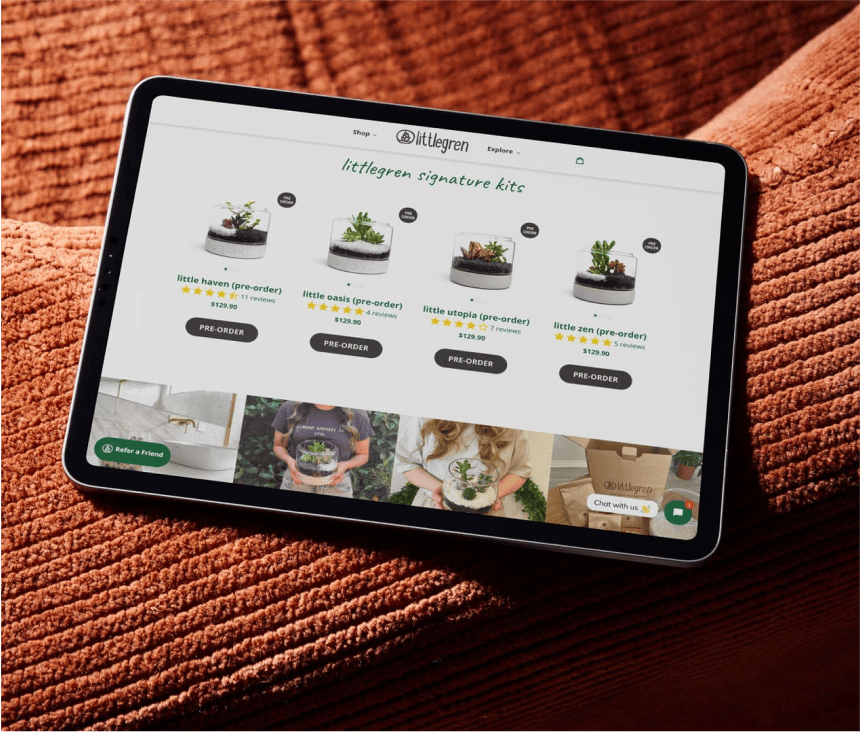
We design and build websites that earn their keep. Shopify, Webflow, WordPress or a headless CMS - chosen for your business, not our convenience. After we rebuilt littlegren's online store, sales increased 300 percent year on year.
A website is not a brochure, it is a channel, and the only honest way to judge web design and development work is by what happened to the business afterwards. After we rebuilt littlegren's online store, sales increased 300 percent year on year. Schnuzzle saw a 200 percent return on investment within the launch period and expanded from Australia to the USA. For Crop Shop Boutique we connected ShipBob, Klaviyo and Shopify in a 2-week development cycle, automating 100 percent of pre-shipment customer notifications and eliminating the manual CSV export workflow entirely. Alongside those, the One Playground site we built scores 100 out of 100 on Lighthouse best practices, with a 45-second content publish pipeline - which is what it looks like when performance and the editing experience are designed together rather than traded against each other. Different platforms, different sectors, one pattern: decide what the website has to achieve commercially, then build the smallest thing that achieves it and keep improving it on evidence. That is the difference between a website design company that ships a design file and a website development company that ships a result. If you are still shortlisting, we have written up how to choose the best web app developers in Australia and what a build costs.

Shopify store rebuild · Australia

Shopify e-commerce launch · Australia to USA
Shopify integration build · Australia
littlegren sells DIY terrarium kits, and the product was never the problem. The store was. After we rebuilt littlegren's online store, sales increased 300 percent year on year. That number is worth unpacking, because it is the argument for treating a website redesign as a commercial exercise rather than a visual refresh. An e-commerce rebuild only moves revenue if it fixes the specific places the old store was leaking: how quickly a first-time visitor understands what is being sold, how much friction sits between the product page and a completed checkout, how the catalogue is structured so that search engines can find individual products rather than only the homepage, and how fast the whole thing loads on a phone on mobile data. None of that is decided in a design file - it is decided in Scoping & Design, where we work out what the store has to do before anyone picks a colour. The platform choice followed the business rather than led it. Shopify was right for littlegren because payments, tax, shipping and fulfilment were solved problems that did not need rebuilding, which left the budget free to spend on the parts that were actually costing them sales. If you are comparing website design and development companies for an e-commerce rebuild, ask each of them which number they expect to move and how they will know.

PixelForce holds Web Excellence Awards for both website and app work, alongside Apple Best of Developers, Watch and TV App of the Year, and Top Clutch App Development, Software Development and User Experience Company in Australia. We are an AWS Advanced Tier Partner with 15+ AWS-accredited engineers, and hold a 99.99 percent uptime rate across 100+ shipped products. On a website that uptime figure is not decoration: an outage on a trading e-commerce store is lost revenue measured in hours, and a site that falls over during a campaign wastes the media spend that drove the traffic to it. The same engineering discipline that keeps a mobile platform up keeps a website up, which is why we do not run a separate, more casual standard for web builds.





Four reasons Australian businesses pick PixelForce as their website design and development company rather than a template shop, a freelance web design contractor or an offshore build house. The web is the part of the market most crowded with cheap options, and most of them are genuinely fine right up until the site has to do something specific - integrate with the systems you already run, handle real transaction volume, support a content team, meet an accessibility obligation, or hold the search rankings you spent years earning. What follows is what changes when the website is load-bearing for revenue: platform advice that is not a sales pitch, engineering standards borrowed from our product work, an in-house Adelaide team you speak to directly, and a commercial structure that tells you the number before you commit to the build.
Most web agencies sell one platform because that is the one they resource for, and the recommendation you get is really a description of their team. We build on Shopify, Webflow, WordPress and headless CMS platforms including Craft, and the choice is made in Phase 1 with the trade-offs written down. The 1-3-1 method frames it: one problem, three options with their consequences across budget, timeline and scope, and one recommendation. Sometimes that recommendation is the cheaper platform, and occasionally it is that you do not need us at all. littlegren went to Shopify because payments and fulfilment were solved problems worth buying rather than building.
Speed is a ranking signal and a conversion factor, and on most websites it is lost in the design phase rather than the build. We set a performance budget before layouts are approved, so imagery, fonts, third-party scripts and animation are costed against it rather than added afterwards and apologised for. The One Playground site we built scores 100 out of 100 on Lighthouse best practices, with a 45-second content publish pipeline. Core Web Vitals, semantic markup, accessible heading structure and structured data are part of the definition of done here, not an optimisation project sold to you six months after launch.
The people who scope your website are the people who design it, build it and ship it. PixelForce runs 100% in-house development from an Adelaide headquarters, so there is no subcontracting chain between the conversation and the code and no timezone gap turning a two-minute clarification into a two-day round trip. On web projects that matters more than clients expect, because content, copy and stakeholder feedback all land late and all need decisions quickly. Cadence is fixed and visible: squad sessions every 2 weeks, planning every 4 weeks, and sprint demos you attend rather than a status email you interpret.
No development quote is issued without a completed Phase 1, and budget alignment happens at the first consultation rather than after a proposal lands. We never scope something a client cannot afford to build. If Scoping & Design shows the honest number sits above your budget, we will say so and show you what a smaller version one looks like. If it shows a site builder would serve you perfectly well for another year, we will say that too - declining a project, or recommending against building, is a valid outcome here. Your website is hosted on your own cloud account and the intellectual property is yours, so nothing about the arrangement depends on you staying.
Six website design services and web development services we ship repeatedly for Australian businesses - from scoping and UX through custom website development, e-commerce and Shopify website development, headless CMS builds, website redesign and replatforming, and the support and optimisation work that follows launch. The technical building blocks repeat across projects: a content model, page templates, a checkout or enquiry path, integrations, analytics, hosting and a release pipeline. What changes is which commercial job the website has to do. Take one service or combine several into a single engagement scoped in Phase 1. If what you actually need is an installable, offline-capable app experience delivered through the browser, that is a different build and it lives on our progressive web app development page.
Phase 1 Scoping & Design, the mandatory first step of every website build. Preliminaries, then two strategic workshops covering business requirements, product requirements, design direction and the scope of version one. You leave with a Business Requirements Document, an enterprise-grade design system, high-fidelity designs for every page template, a Product Requirements Document and a fixed-cost Statement of Work for development. It is a standalone commitment on purpose, so you can stop after it if the evidence says stop. No Blueprint, no Build.
Custom website development for businesses whose requirements have outgrown a template, delivered by website developers in Australia rather than a subcontracted offshore team - bespoke page templates, custom application logic, integrations with the CRM, ERP, booking or inventory systems you already run, role-based administration, and an editing experience your marketing team can actually use without a developer. Built on your own cloud account with the intellectual property transferring to you, on infrastructure run by an AWS Advanced Tier Partner with 15+ AWS-accredited engineers. This is the service for a website that is doing real operational work rather than describing what your business does.
Shopify website development and wider ecommerce website development for brands selling physical product, where payments, tax, shipping and fulfilment are solved problems worth buying rather than rebuilding. We rebuilt littlegren's online store and sales increased 300 percent year on year. Schnuzzle saw a 200 percent return on investment within the launch period and expanded from Australia to the USA. For Crop Shop Boutique we connected ShipBob, Klaviyo and Shopify in a 2-week development cycle, automating 100 percent of pre-shipment customer notifications. Payment and platform fees change, so check each provider's current pricing.
A headless CMS build separates the content from the presentation, which is the right architecture when one content set has to feed a website, an app and a partner channel, when content relationships are genuinely complex, or when the site must sit alongside an existing product. We build on Craft and comparable headless platforms including Contentful, Sanity and Strapi. It offers the most control over performance, structure and structured data of any option here, and it costs more up front than a template, which is exactly why the recommendation is made in Phase 1 rather than assumed.
A website redesign carries an obligation a new build does not: it must not lose the search equity the old site earned. Most redesign failures are redirect and content-model failures rather than design failures. We start by auditing which pages earn traffic and revenue, which URLs must survive and what the current content model cannot express, then rebuild against that. Content migration, URL mapping and redirects, structured data, analytics continuity and a staged release are part of the scope, not a variation raised afterwards.
Phase 3, where a website stops being a project and becomes a product. Warranty, Monitoring & Support covers critical-defect warranty, 24/7 infrastructure monitoring, business-hours incident response, notification of required third-party updates with costs stated upfront, and a monthly Platform Health Report, with technical support capped at seven hours per month. Most clients whose website is a real revenue channel step up to the Product Retainer, which includes all of that and adds a roadmap workshop, continuous sprints and quarterly business reviews, running per four-week cycle across tiers from Steady through to Momentum.
Schnuzzle makes scented dog toys. Schnuzzle saw a 200 percent return on investment within the launch period and expanded from Australia to the USA. For a new consumer brand that combination is the whole test of an e-commerce website: it has to return more than it cost quickly enough to fund the next thing, and it has to still work when the market changes underneath it. Expanding into the United States is not a marketing decision that a website merely survives - it changes currency, shipping logic, tax treatment, delivery expectations and the content that has to appear on a product page before an American shopper will trust it. A store built as a one-off around a single market makes that expansion a rebuild. A store built with the second market in mind makes it a configuration change. That distinction is settled in Phase 1 Scoping & Design, before a single template is drawn, by asking what the business intends to do next rather than only what it does today. It is the single most useful question to put to any website development company you are considering, because the answer tells you whether they are designing for launch day or for the three years after it.


Three engagement models, in the order they normally run. Scope is what drives everything below, which is exactly why Scoping & Design comes first and why no development commitment is made without it. Website design cost and website development cost are driven by what is actually being built: a content-led marketing site on a headless CMS is a far smaller build than a trading e-commerce platform with custom fulfilment, subscription logic and several third-party integrations. Businesses asking how much a website costs in Australia should read the two build phases together, because a real website needs both phases. Phase 1 is deliberately a separate decision, so the commitment always matches the evidence you have.
The mandatory first phase of every website build, and a standalone commitment. Preliminaries and two strategic workshops produce the Business Requirements Document, the information architecture and content model, a complete enterprise-grade UX/UI design system covering every page template and the key administration screens, a Product Requirements Document, and a fixed-cost Statement of Work for the build. Best for any business that has a website ambition and no development-ready blueprint. You can stop here if the evidence says stop, and some do. No Blueprint, no Build.
Development, QA and release against the signed Statement of Work: foundation setup, the content model and administration experience, the front-end build against the approved templates, integrations with payment, shipping, email, CRM and analytics platforms, cloud infrastructure and deployment pipelines, internal QA against the PRD acceptance criteria, client User Acceptance Testing, then launch. Where the site is a replacement rather than a first build, content migration, URL mapping and redirects sit inside this phase too. A tight first release is a recommendation, not a limit - with a larger budget we still advise holding version one to that scope and spending the rest on evidence-led iteration afterwards, because the most valuable changes to a website are the ones informed by how people actually used the previous version.
Where a launched website becomes a product. There are two ways to engage after launch. Option 1, Warranty, Monitoring & Support, covers critical-defect warranty, 24/7 infrastructure monitoring, business-hours incident response, notification of required third-party updates with costs stated upfront, and a monthly Platform Health Report - protection without the complexity. Option 2, the Product Retainer, includes everything in Option 1 and adds a roadmap workshop in month one, continuous sprints shipping designed features into production, and quarterly business reviews. It runs per four-week cycle against a committed story-point capacity, across tiers from Steady through to Momentum, with Enterprise on application. The retainer is where the longest partnerships live, because it is the only option that keeps building.
Six layers that appear in nearly every website we build, whatever the platform. This is the part businesses comparing website development companies should look hardest at, because the difference between a site that earns and a site that merely exists lives in the plumbing - whether the content model lets your team publish without a developer, whether the checkout or enquiry path is instrumented well enough to show you where people leave, whether the technical SEO foundation can hold a ranking, and whether a fix can ship the same week it is found. Every layer below is built to be extended, because the point of launch day is what comes after it.
The structure your content lives in and the screens your team edits it through. Get this wrong and every future page becomes a developer ticket, which is the single most common reason a website ages badly.
The layer that decides whether good content can rank at all. It is far cheaper to build in than to retrofit, and retrofitting is what most website redesign rescue work turns out to be.
Speed is both a ranking signal and a conversion factor, and it is won in the build rather than bolted on. We agree a performance budget before layouts are approved and hold the build to it.
The specific journey that turns a visitor into revenue, whether that ends in a checkout or an enquiry. Designed deliberately and instrumented so that drop-off is visible rather than guessed at.
The work that is cheapest to do during the build and most expensive to do afterwards. Accessible markup also happens to be the markup search engines read most reliably.
Cloud infrastructure, CI/CD and monitoring on your own account, so shipping a fix takes hours rather than a fortnight and a campaign traffic spike is a good day rather than an outage.
The same canonical PixelForce engagement model behind 100+ shipped products and $1.5B+ in combined client revenue, applied to your website. The 1-3-1 method runs through every conversation - one problem, three options with honest trade-offs across budget, timeline and scope, one recommendation. No Blueprint, no Build.
A free, no-obligation conversation to find the right path for your website before you commit a dollar.
Everything you need to build with total confidence - a fully costed, designed plan with no scope surprises.
From approved designs to your live website, built and tested at a steady sprint cadence.
We do not disappear at launch - monitoring, warranty, and an optional retainer keep your website growing.
Selected website and platform work, built by a 100% in-house Adelaide team you would actually work with on your project. Businesses comparing website design companies should read these for the decisions rather than the screenshots - which platform was chosen and why, what was in version one, what was deliberately held back, and what the first months of real traffic changed. Between them they cover the profiles we see most often on web builds: consumer brands selling physical product, studios and operators running a content and booking operation, and businesses replatforming a site that had stopped keeping up with them.

How we built EzLicence, Australia's largest marketplace for driving lessons

How we helped build SWEAT, from an Adelaide startup to a global fitness platform

A working prototype first, so the hard decisions were made before the expensive ones.

A fast coaching website - 100/100 for best practices - the OneCoach team updates in seconds
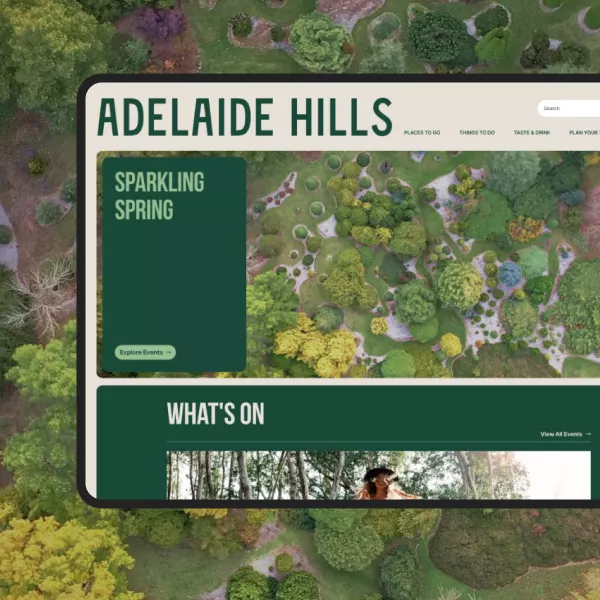
One destination website carrying a whole region's operators, events and trails.
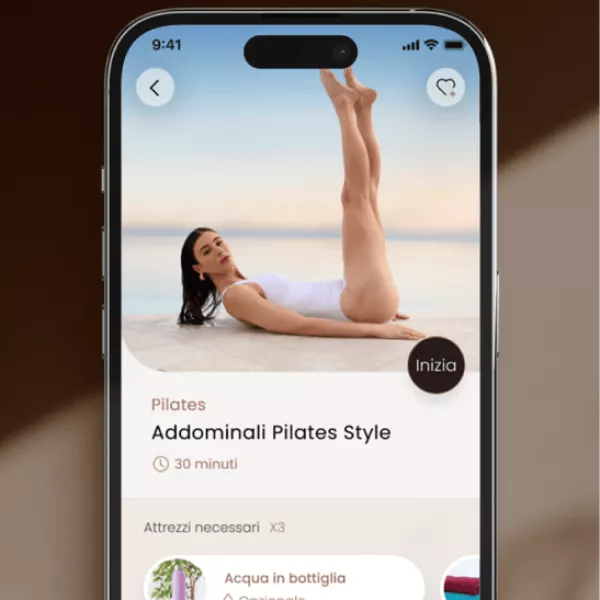
How we built Traininpink into the number one female-focused Pilates and fitness app in Italy.

How we turned Sara Colquhoun's studio expertise into a global Pilates platform in three months

A regulator's website where finding the right form is the whole job.
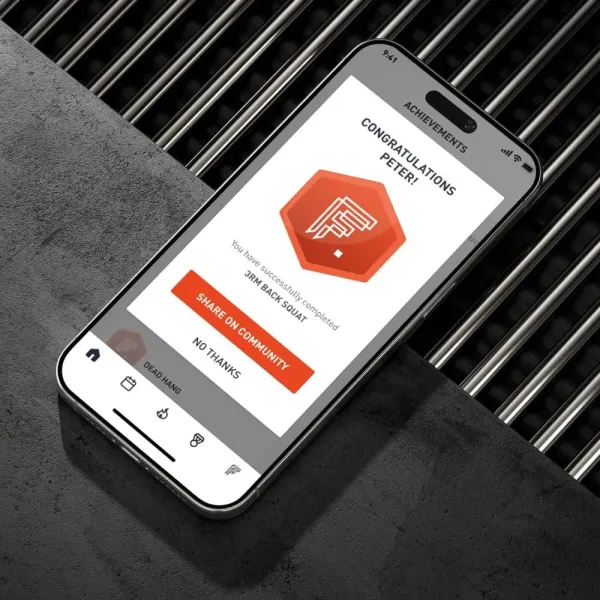
One member app and one franchisee operations portal, running across 100+ gyms and 50,000+ active members.
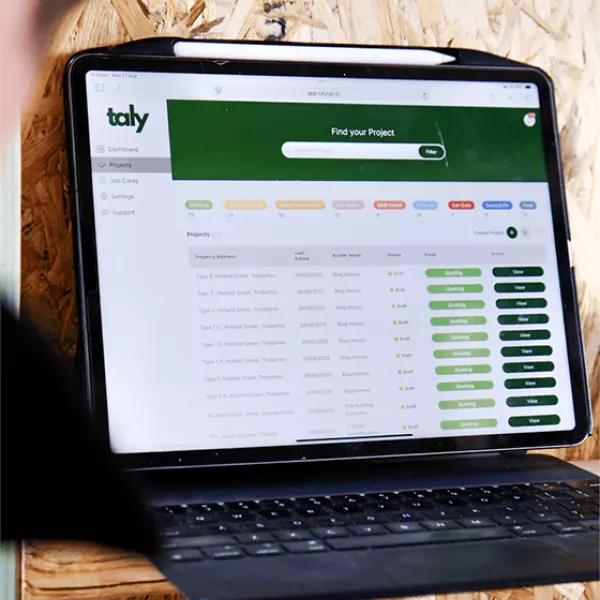
The plan, the job card and the numbers in one place, live for the office and the site at once.
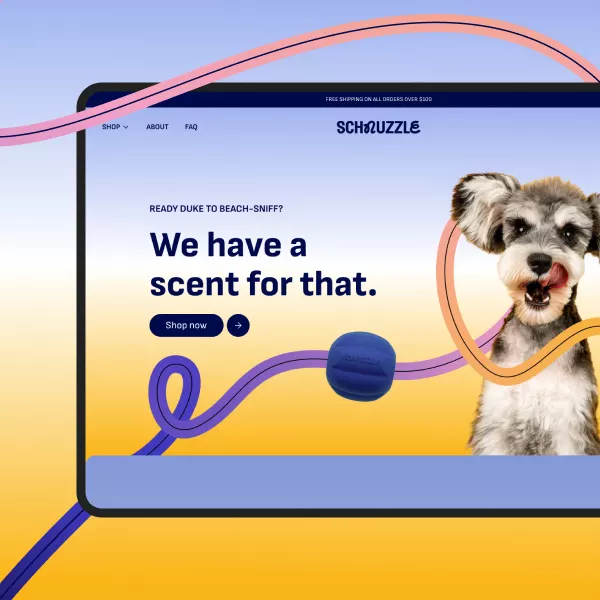
A store built to sell a product nobody can smell through a screen, with a 200 percent return on investment within the launch period.
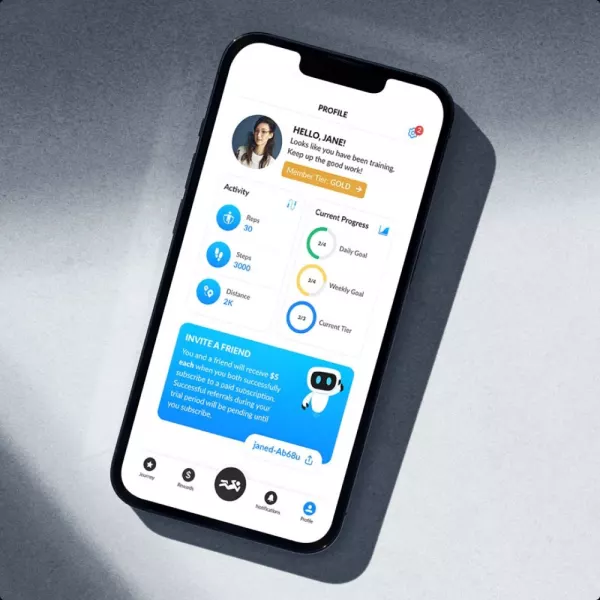
How we built a fitness app that counted every rep from the phone camera and paid people for the work.
The questions businesses ask before committing to a website build - what website design and development costs in Australia, how long it takes, how to choose a website development company, the difference between design and development, whether website design affects SEO, which platform to build on, whether you need a designer at all, what a website redesign involves, and what happens after launch. Answers below come from shipping websites and platforms for consumer brands, studios and operators across 100+ products. If your question is not here, ask it on a discovery call - that call exists for exactly this.
Website design and development is priced against the scope of the site, never off a rate card. There are two build phases and you commit to them separately.
Phase 1 - Scoping & Design is a standalone commitment quoted as a fixed cost. It produces the Business Requirements Document, a complete enterprise-grade UX/UI design covering every page template, the Product Requirements Document, and a fixed-cost Statement of Work for the build itself.
Phase 2 - Development, QA and Release is quoted against that Statement of Work, set by what is genuinely being built. A content-led marketing site on a headless CMS is the simpler end of that. A trading e-commerce platform with custom fulfilment, subscription logic and third-party integrations costs considerably more. Where a budget stretches further than the scope requires, we advise keeping version one tightly scoped and channelling the remainder into post-launch iteration, where the roadmap is driven by real user behaviour rather than assumptions made before launch.
Pricing a website before anyone has defined the content model, the integrations and the conversion journey produces a number that is wrong in one direction or the other. That is why Scoping & Design comes first, and why no development quote is issued without it. Budget alignment happens at the first consultation, not after a proposal lands - we never scope something a client cannot afford to build.
Website design and development timelines are an output of Phase 1 Scoping and Design rather than a promise made before it, and the full schedule and milestones arrive with the signed Statement of Work.
The honest answer is that the timeline is an output of Phase 1, not a promise made before it. Anyone quoting you a duration before they know your content model, your integrations and your approval process is guessing.
What is fixed is the shape. Phase 1 Scoping & Design runs preliminaries followed by two strategic workshops covering business requirements, product requirements, design direction and the scope of version one. It ends with a signed, fixed-cost Statement of Work containing the full schedule and milestones for the build. Phase 2 then runs against those milestones - foundation setup, backend and content model, the front-end build and integration, internal QA against the PRD acceptance criteria, client User Acceptance Testing, then release.
For a real data point: for Pilates Obsession we built and launched a full-featured platform - structured programmes, professional video and reliable infrastructure - live within 12 weeks and on budget. Your project may be shorter or longer, and Phase 1 exists precisely so that the number you are given is one that holds. Cadence during the build is fixed and visible: squad sessions every 2 weeks, planning every 4 weeks, and sprint demos you attend.
Choosing a website design and development company is best done by asking every firm on your shortlist the same five questions and comparing the answers, rather than comparing portfolios.
Ask every company on your list the same five questions, and compare the answers rather than the portfolios.
Who actually writes the code? Many agencies subcontract the build offshore after selling you a local design team. PixelForce runs 100% in-house development from an Adelaide headquarters, so the people who scope your site are the people who build it.
Who owns the result? Ask whether the site is hosted on your infrastructure or theirs, and when the intellectual property transfers. Your IP should be yours, hosted on your own cloud account, not held inside a proprietary platform you cannot leave.
What is the number, and what makes it move? A fixed price quoted before discovery is either padded or about to become a variation. Ask what drives the range up and down.
What happens after launch? A website nobody maintains degrades. Ask what the support model is and what it costs, before you sign.
Can they show a measured outcome, not a screenshot? After we rebuilt littlegren's online store, sales increased 300 percent year on year. Schnuzzle saw a 200 percent return on investment within the launch period and expanded from Australia to the USA. The One Playground site we built scores 100 out of 100 on Lighthouse best practices, with a 45-second content publish pipeline. Ask for numbers like those, and ask who verified them.
Website design decides what the site looks like, how it is structured and how someone moves through it. Website development is the engineering that makes it real, fast and maintainable. Both sit inside a single engagement here, but they belong to different phases and answer different questions.
Design covers the information architecture, the content model, the page templates, the design system - colour, typography, accessibility, iconography, components - and high-fidelity layouts for every template plus the key administration screens. It happens in Phase 1 and produces something a developer can build from without guessing.
Development covers the front-end build, the content management system and its editing experience, integrations with payment, shipping, email and analytics platforms, hosting and deployment pipelines, performance work, and the security and accessibility hardening that only shows up in the code. It happens in Phase 2, against a signed Statement of Work.
The reason the two are sold together is that splitting them across two suppliers moves all the risk onto you. When a design cannot be built to the performance budget, or a developer quietly redraws a layout to make it easier, nobody owns the gap. One team designing and building removes that gap entirely.
Website design affects SEO substantially, mostly through decisions made before any copy is written: information architecture, performance, semantic and accessible markup, structured data, and whether the content model lets your team publish depth.
Yes, substantially - and mostly through decisions made long before anyone writes a line of copy.
Page structure. How the site is organised determines how search engines understand what it is about. A flat, sensible information architecture with one clear page per topic outranks a beautiful site whose content is buried three clicks deep or trapped inside a carousel.
Performance. Core Web Vitals are a ranking signal, and design choices drive them: uncompressed hero imagery, a heavy font stack, third-party embeds and animation libraries all cost load time. The One Playground site we built scores 100 out of 100 on Lighthouse best practices - that is a design and engineering outcome, not a plugin.
Semantic and accessible markup. A single H1, a real heading hierarchy, descriptive alternative text, meaningful link labels and proper landmark elements are what accessibility requires and what crawlers read. The two goals point in the same direction.
Structured data. Product, Article, Breadcrumb, Organisation and FAQ schema decide whether your pages can be quoted by AI search and answer engines rather than merely listed.
Content that can actually be edited. A design with no room for depth forces thin pages. A content model your marketing team can extend without a developer is worth more over three years than any single ranking tactic.
The right platform for your website depends on your business, your team and your roadmap: Shopify for physical product, WordPress for content-heavy publishing, Webflow for design-led marketing sites, and a headless CMS for complex or multi-front-end products.
Whichever one fits your business, your team and your roadmap. We are platform-agnostic on purpose, and the recommendation is made in Phase 1 with the trade-offs written down rather than asserted.
Shopify is the default when you are selling physical product and want the payment, tax, shipping and fulfilment stack solved rather than built. We rebuilt littlegren on Shopify and their sales increased 300 percent year on year, and we built Schnuzzle, which saw a 200 percent return on investment within the launch period and expanded from Australia to the USA.
WordPress suits content-heavy marketing sites where a large non-technical team publishes frequently and a deep plugin ecosystem is genuinely useful. It needs disciplined maintenance to stay fast and secure.
Webflow suits design-led marketing sites where visual fidelity and speed to launch matter more than custom application logic, and where marketers want to change layouts without a deployment.
A headless CMS - Craft, Contentful, Sanity or Strapi - suits sites that must feed several front-ends, support complex content relationships, or sit alongside an existing product. It gives the most control over performance and structure, and costs more up front.
The wrong reason to pick a platform is that your agency only builds on one. Ask any company you are considering which platforms they decline to use, and why.
Whether you need a professional website design and development team depends on how much work the site does: a site builder is fine for a simple presence, but not for a revenue-critical, integrated or search-dependent site.
Sometimes you genuinely do not need one, and we will say so. A site builder is the right answer when you need a credible presence quickly, your requirements are a handful of pages, and nothing about the site is load-bearing for revenue yet. Spending six figures to find out whether anyone wants what you sell is a bad trade, and declining a project or recommending against building is a valid outcome here.
You need a professional website design and development team when the site is doing real work: when it is the main sales channel, when it has to integrate with inventory, bookings, payments or a CRM, when there is a content operation behind it, when accessibility or regulatory obligations apply, or when organic search is a serious acquisition channel and the technical foundation has to support it.
The other trigger is cost of change. Template sites are cheap to start and expensive to outgrow, because the first genuinely custom requirement usually means starting again. If you can see that requirement coming within two years, building properly now is the cheaper path. Budget alignment happens at the first consultation, so you find out which side of that line you are on before spending anything.
A website redesign is worth doing when the site is losing you money, and not before. The signals worth acting on are measurable: conversion has fallen while traffic has held, the site fails Core Web Vitals on mobile, your team cannot publish without a developer, the platform no longer receives security updates, or the brand has moved on and the site has not.
The work runs through the same two phases as a new build, with one important addition. Phase 1 Scoping & Design starts by auditing what already exists - which pages earn traffic, which earn revenue, what the current content model can and cannot express, and which URLs must survive. It then produces the new information architecture, the design system and the templates.
Phase 2 builds it and carries the migration: content migration, URL mapping and redirects, structured data, analytics continuity and a staged release. The addition is that a redesign has an obligation a new build does not - it must not lose the search equity the old site earned. Most redesign horror stories are redirect failures, not design failures. We rebuilt littlegren's online store and sales increased 300 percent year on year, which is the outcome a redesign should be measured against.
After a website launches, PixelForce supports it through Phase 3, either as Warranty, Monitoring and Support on a flat monthly fee, or as a Product Retainer priced per four-week cycle against a committed story-point capacity.
Phase 3 - Post Launch Support. There are two ways to engage, and you choose after launch rather than before it.
Option 1 - Warranty, Monitoring & Support is a flat monthly fee. It covers critical defect resolution under warranty, 24/7 infrastructure monitoring with proactive alerts, business-hours response to outages, clear notification of required third-party updates with the cost implications stated upfront, and a monthly review with a Platform Health Report. Technical support for customer ticket investigation is capped at seven hours per month. It is protection without the complexity.
Option 2 - Product Retainer includes everything in Option 1 and adds continuous improvement: a product roadmap workshop in month one, regular sprints delivering designed features into production, structured sprint planning, transparent progress reporting and quarterly business reviews. It is priced per four-week cycle against a committed story-point capacity, in five tiers named Steady, Growth, Scale, Velocity and Momentum, with Enterprise on application.
Most clients whose website is a serious revenue channel take Option 2, because a website is not a project that finishes - it is a product that either keeps improving against real user behaviour or quietly decays. Data services are available alongside either option once the platform is live.
Book a free consultation and we will talk through what your website actually has to do - the searches it needs to win, the customers it needs to convert, and the platform that fits how your team works day to day. You will get the 1-3-1 recommendation: one problem, three options with their trade-offs, and one recommendation across budget, timeline and scope. No development quote is issued without a completed Phase 1, so you will always know exactly what you are committing to.


