littlegren sold a product that is genuinely difficult to sell online. A terrarium kit is bought on how it will look on a shelf and on whether the buyer believes they can actually assemble it and keep it alive, and neither of those questions is answered by a product title and a price. The business had the product, the sourcing and the customers who found it in person, but no e-commerce channel that could carry the visual and educational weight the category demands. Without it, growth stayed tied to word of mouth and retail partners, and every customer who saw a terrarium somewhere and went looking for it online found nothing to buy from.

A Shopify store built for a product people buy with their eyes, and sales that increased 300 percent year on year.
A living product, sold online
littlegren sold ready-to-assemble terrarium kits: the glass, the substrate, the drainage, the charcoal, the plants and the instructions, in one box. PixelForce designed and built the Shopify store that sold them, with the product photography, the customisation and the care content the category needs. After we rebuilt littlegren's online store, sales increased 300 percent year on year.
Sales increase 300%
Platform Shopify
Kit configuration Built to order
The Problem
The Solution
PixelForce designed and built the store on Shopify, chosen deliberately so that a small team could run the catalogue, the stock and the orders without a developer standing behind them. The UX/UI was built around the product rather than around a template: photography at the size the product deserves, kit contents made explicit, and care information placed at the point of the decision rather than buried in a support page. Kit configuration was handled through the product model so a customer could choose a vessel, a base and plant options and still see one clear price.
The Outcome
After we rebuilt littlegren's online store, sales increased 300 percent year on year. The brand moved from depending on word of mouth and retail partners to owning a direct sales channel its own team could operate and extend.
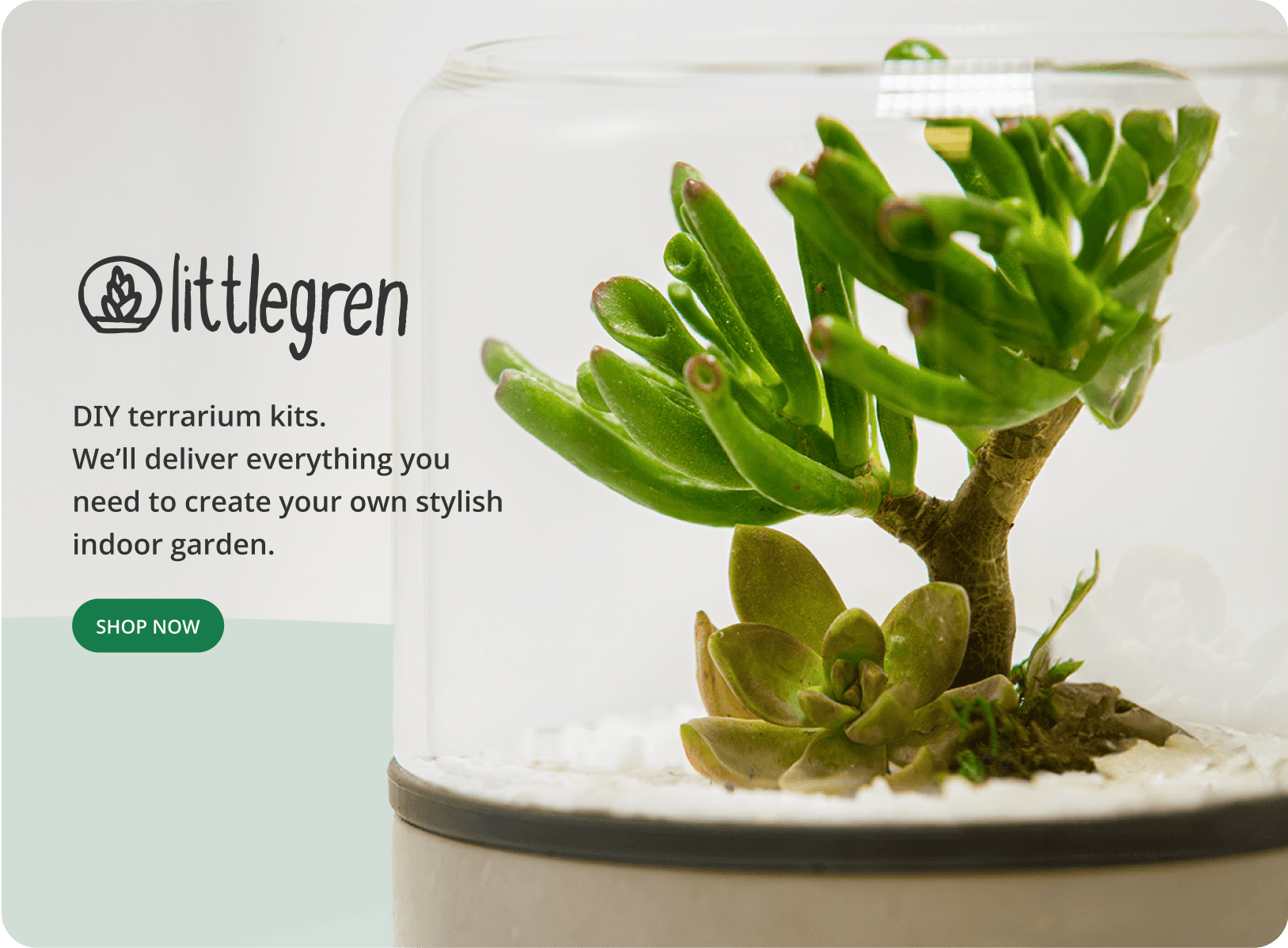
A product that sells itself in person and not on a page
littlegren was an Australian brand selling ready-to-assemble DIY terrarium kits. Each kit contained everything a first-time builder needed in one box: a glass vessel, potting substrate, crushed stone for drainage, activated charcoal to manage moisture, selected live plants and instructions written for someone who had never done it before. The proposition was the whole point of the product. Terrariums look like something you need to be good at plants to own, and the kit was the argument that you do not.
The gap was the sales channel. Terrarium kits are discovered visually - somebody sees one in a photograph, in a friend's living room or on a shelf, and goes looking for it. littlegren had nowhere for that person to land. Building the store was therefore not a matter of putting a catalogue online. The site had to do the work a shop assistant does for a living product: show it properly, say exactly what is in the box, answer the questions that stop a purchase, and reassure a buyer that live plants can be shipped and will arrive intact. It also had to be a store the littlegren team could actually run, because a brand of that size cannot route every seasonal plant change and stock adjustment through a developer.
A visual product on a text-shaped channel
Terrarium kits are bought on how they look. The store had to be built around photography at full size rather than treating images as thumbnails beside a specification list.
Buyers who did not know if they could do it
The main objection was not price, it was capability. Care requirements, light needs and assembly steps had to sit inside the buying decision rather than behind a support link.
Live and fragile stock
Glass and living plants have to be packed, shipped and stocked differently to ordinary retail goods, and plant availability moves with the season rather than with a purchase order.
A small team, no developer on call
The people running the brand needed to add products, change stock and update content themselves. Anything that required a developer would have stopped being maintained within a season.
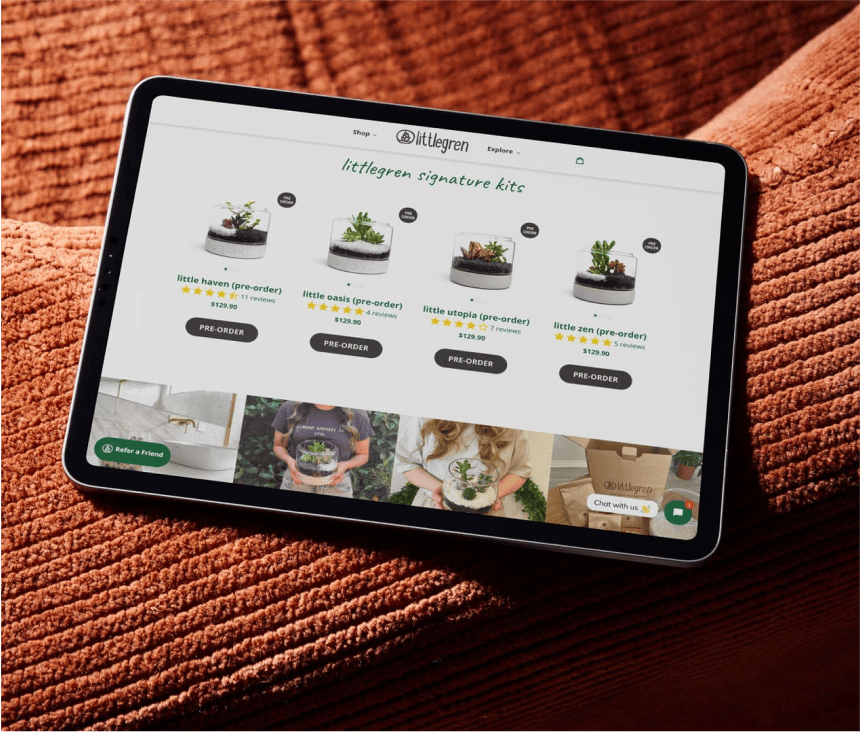
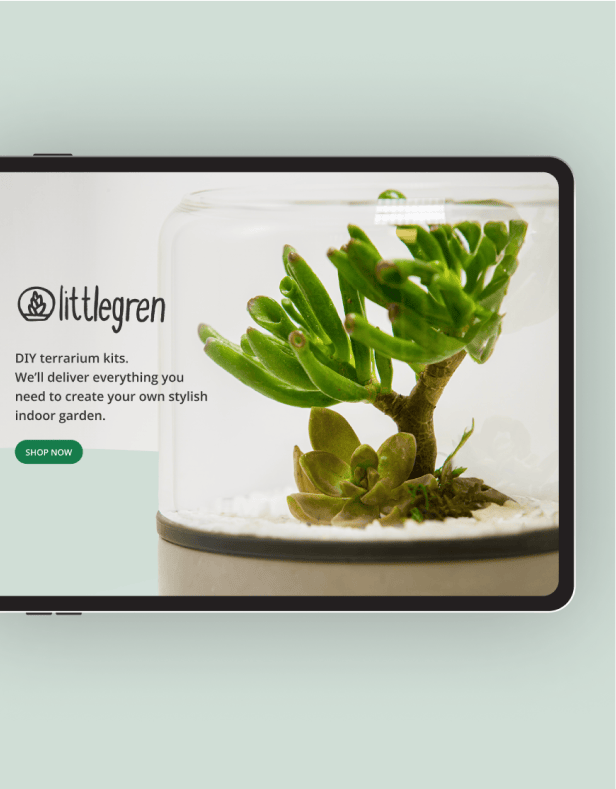
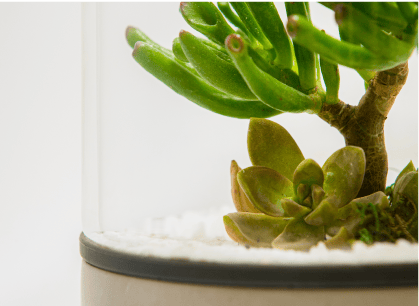

littlegren and PixelForce are both based in Adelaide, which suited a project of this size. The engagement was short and specific, and the useful conversations were about the product rather than the software: what goes in a kit, what a first-time buyer gets wrong, which plants survive a courier. The store was handed over as something the client's own team could run without us.
Hinney Lo Founder & CEO, PixelForce
Book a consultationAn e-commerce build is usually sold as a technology project and it almost never is one. The decisions that move the number are which three facts appear next to the buy button. Get those wrong and the fastest checkout in the world will not save it.
Swipe to explore
How we built the store
The engagement ran the way every PixelForce engagement does, with Phase 1 Scoping and Design before any development. Scoping and design always precedes development here, and on a small e-commerce build that is exactly where the value is concentrated: the decisions that determined whether this store worked were about which product information appears at which moment, not about which framework rendered it. Phase 1 settled the catalogue structure, the kit configuration model and the UX/UI before a page was built.
Shopify was the platform choice, and it was a deliberate one rather than a default. littlegren needed a store whose day-to-day operation belonged to the client: adding a seasonal plant, adjusting stock, publishing a care guide. A hosted platform put payments, tax, shipping and cart and checkout on well-tested foundations, which meant the budget went into the parts of the store that were specific to littlegren instead of into rebuilding commerce plumbing. The theme was customised to the brand rather than adopted as shipped, so the layout gave photography the room the product needed and kept the interface quiet around it.
The build then concentrated on the two things that decide a purchase in this category. The first is knowing exactly what arrives, so product pages set out kit contents, vessel dimensions, the plant varieties included and their light and watering needs, which is friction removed before checkout rather than reassurance added after it. The second is configuration: customers wanted to choose a vessel, a base and plant options, so kits were modelled as configurable products with stock tracked at the component level, which stops the store selling a combination it cannot actually pack. Care guides and design content were published as part of the store rather than alongside it, which served buyers who were still deciding and gave the site the depth it needed for search visibility against the queries people actually type when they are thinking about a terrarium and not yet about a brand.
Glass · Soil · Stone · Plants
Everything in one box, instructions included
A store built so a first-time buyer believes they can keep it alive.
- Photography-first product pages
- Kit configuration
- Component-level stock
- Care information inside the decision
- Content that earns search traffic
- A store the client could run
01 06
Photography-first product pages
Terrarium kits are bought on appearance, so the layout gives images the full width of the page rather than treating them as thumbnails beside a specification table. Lifestyle photography showing a finished terrarium in a real room does the work a product description cannot, because the buyer is not purchasing components, they are purchasing the thing on the shelf at the end.
02 06
Kit configuration
Customers could select a vessel, a base and plant options rather than being limited to fixed kits. These were modelled as configurable products with a single clear price, so choice never turned into confusion at the point of decision.
03 06
Component-level stock
Because kits were assembled from parts, stock was tracked at the component level rather than at the finished-kit level. A shortage of one plant variety made only the combinations that use it unavailable, instead of quietly overselling a kit the team could not actually pack.
04 06
Care information inside the decision
Light requirements, watering needs, plant varieties and vessel dimensions were placed on the product page itself. In this category the biggest objection is not price, it is whether the buyer can keep the thing alive, so answering that before checkout removes the reason most carts are abandoned.
05 06
Content that earns search traffic
Care guides and design content were published as part of the store. People searching for how to look after a terrarium are not yet searching for a brand, and content that answers the question properly is how a small store gets discovered before it can afford to buy the attention.
06 06
A store the client could run
Shopify was chosen so that adding a product, changing stock or publishing a guide belonged to the littlegren team rather than to a developer. For a brand of this size that is a durability decision - a store that needs an agency to update it stops being updated.
Services on the littlegren build
Frequently Asked Questions
littlegren was an Australian brand selling ready-to-assemble DIY terrarium kits, each containing a glass vessel, potting substrate, drainage stone, activated charcoal, live plants and assembly instructions written for beginners. PixelForce designed and built the brand's online store on Shopify. After we rebuilt littlegren's online store, sales increased 300 percent year on year.
PixelForce designed and built a Shopify store covering the UX/UI, a customised theme, photography-led product pages, configurable kits with stock tracked at the component level, care and design content, and payments, shipping and checkout. The store was set up so the littlegren team could run the catalogue, stock and content themselves without developer support.
Because on a small to mid-sized retail brand, a hosted platform puts payments, tax, shipping and checkout on well-tested foundations, so the budget goes into what is specific to the brand instead of into rebuilding commerce plumbing. It also matters operationally: a small team can add products and change stock without a developer. A custom build earns its place when the commerce model itself is unusual, not simply because a brand wants to look distinctive.
A focused e-commerce build on a hosted platform is one of the shorter engagements PixelForce runs, and the timeline is driven far more by product content, photography and catalogue structure than by development. Every engagement follows the same sequence: a free consultation, Phase 1 Scoping and Design, Phase 2 Development, QA and Release, then Phase 3 Post Launch Support. The date is fixed at the end of Phase 1, once the catalogue and content are defined.
Scoping and development are priced separately at PixelForce. Phase 1 Scoping and Design comes first, and Phase 2 Development, QA and Release is quoted against the fixed-cost Statement of Work that Phase 1 produces. A straightforward store on a hosted platform is the least expensive form this takes, while custom configuration, unusual fulfilment or multiple markets moves the cost up. The cost is fixed in that Statement of Work before development starts.
By treating the product page as the whole sales conversation rather than a catalogue record. For a visual and slightly intimidating product that means photography at full width including the product in a real setting, an explicit list of exactly what arrives in the box, and the information that answers the buyer's real objection placed before checkout. For littlegren the objection was never price, it was whether a first-time buyer could keep a terrarium alive.
Yes, provided stock is tracked at the component level rather than at the finished-product level. littlegren's kits let a customer choose a vessel, a base and plant options, so the store used configurable products with component stock. A shortage of a single plant variety then makes only the combinations that use it unavailable, instead of allowing the store to sell a kit that cannot be packed. Getting this wrong is a common cause of oversold orders in configurable retail.
Up next
More products we have designed, built and launched end to end.
SuspectED A forensic field kit in a phone
How we turned a smartphone into a forensic-grade field tool for recording biological threats, working with no network at all.
Sweat: Eight-Language Localisation Eight languages, one codebase
How we localised Sweat into eight languages without forking the product.