
For most of the last 20 years, building software worked like buying real estate.
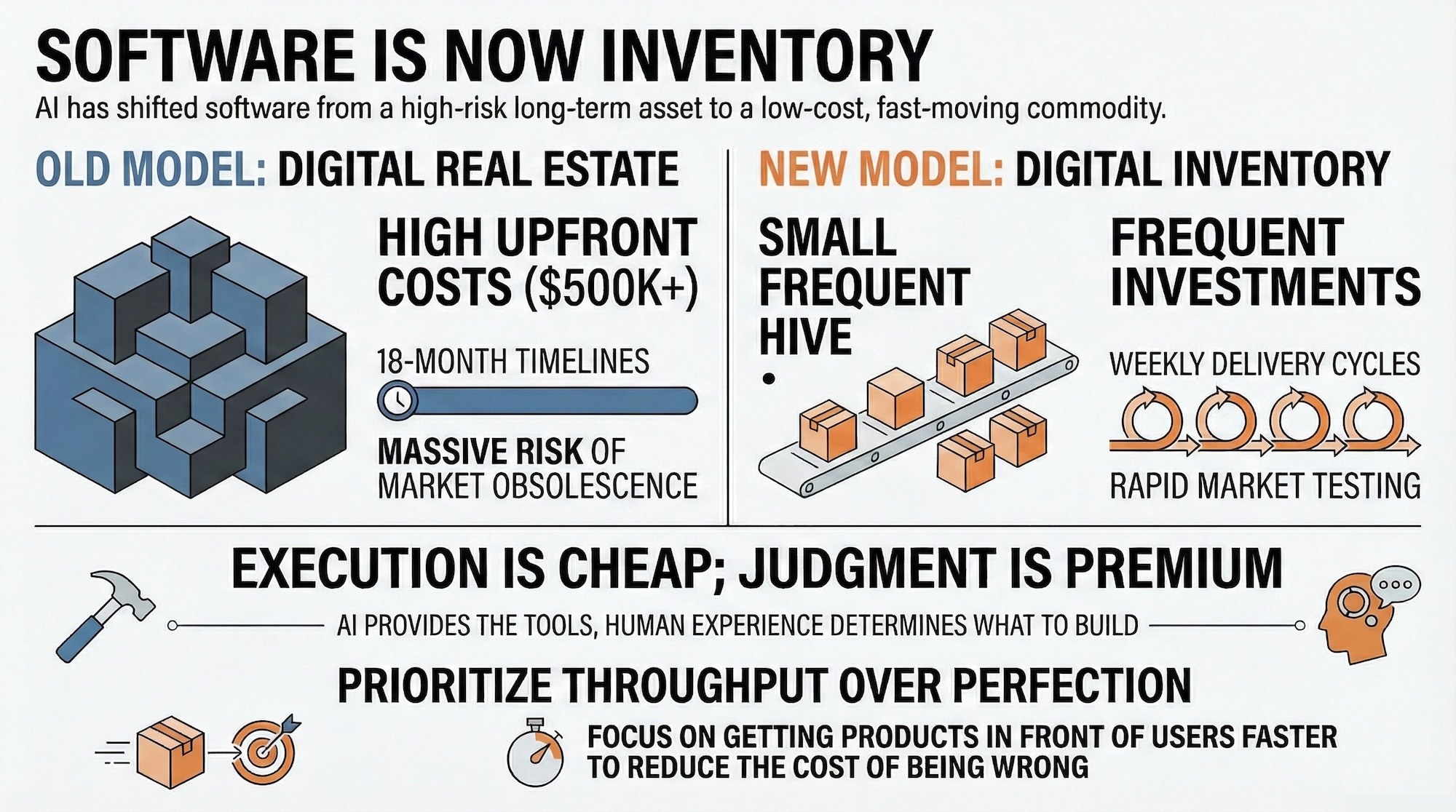
You identified what you needed. You committed a large budget - often $500K, sometimes several million. You waited 12 to 18 months. You launched. Then you spent the next three to five years trying to get a return on that investment before the market shifted or the technology dated underneath you.
The risk was massive. The timelines were long. And because the cost of being wrong was so high, businesses spent months - sometimes years - trying to figure out exactly what to build before they wrote a single line of code.
That model is over.
The shift nobody is talking about clearly enough
The analogy that makes the most sense right now is not real estate. It is consumer goods.
Think about how Procter and Gamble operates. They produce 60 different brands and 16 varieties of soap - all made in the same factory, with different labels. They do not spend three years perfecting one product. They ship fast, test quickly, occupy shelf space aggressively, and iterate based on what sells. Their financing model is throughput accounting. Buy inventory, move it out as fast as possible, recover your cost, repeat.
AI is doing the same thing to software.
Delivery cycles that used to take three to four months now take weeks. Front end builds that once required a team of three for a quarter can now be drafted in days. The cost of building - and the time to see whether something works - has compressed dramatically.
This changes everything about how software should be funded, planned, and delivered.
You no longer need to make a $1.5M bet on a fixed idea and amortise it over five years. You can now invest smaller amounts more frequently, ship faster, test with real users, and adjust course without the catastrophic cost of being wrong. The ROI cycle is shorter. The risk per decision is lower. The pace of iteration is faster.
That is inventory thinking applied to software.
More software will be built, not less
There is a prevailing fear in the tech industry right now that AI will reduce demand for software development. The logic goes: if AI can write code, fewer developers are needed, fewer agencies survive, and fewer products get built.
That is the wrong conclusion.
Lower barriers to entry mean more people will attempt to build. Founders who previously could not afford a platform will now try. Businesses that shelved digital projects because the cost was prohibitive will now start them. The total volume of software being attempted will increase, not decrease.
But here is the part that matters: most of them will get it wrong.
Not because the tools are bad. Because building software was never primarily a technical problem. It was always a business problem. Knowing what to build, in what order, for which users, with which technical foundations - that requires judgment. That requires experience. That requires someone who has shipped 100 products and knows what failure looks like before it arrives.
AI gives people the hammer. It does not teach them what to build with it.
The businesses that thrive in this environment will not be the ones using AI the most. They will be the ones who understand what excellent software looks like and can direct AI to produce it. That is a standard built on experience, not prompts.
What this means in practice
For founders, it means your expectations around timeline and cost should change - but your standards for quality should not. Faster delivery does not mean corners get cut. It means you get to course-correct sooner.
For businesses with existing platforms, it means the competitive gap between you and a well-resourced new entrant has narrowed. Someone can now build a credible alternative to your product in a fraction of the time it took you. The answer is not to slow down. It is to ship faster, occupy more of your market, and build the kind of loyalty that speed alone cannot buy.
For anyone evaluating a digital investment, the question is no longer "can we afford to build this?" It is "how fast can we get this in front of real users, and what will we do with what we learn?"
Why this changes how we work at PixelForce
We have been building platforms that clients depend on since 2013. SWEAT scaled to 50 million users on the same core architecture we built from day one. EzLicence processed over $100 million in bookings. These outcomes were not accidents. They were the result of building with the right foundations from the start.
The throughput model does not change that philosophy. It accelerates it.
We are not moving faster by cutting corners. We are moving faster because better tooling means more of our team's time goes into decisions, not execution. Into thinking, not typing. Into building the right thing faster instead of spending months figuring out what the right thing is.
If you are a founder or business leader trying to make sense of where your digital investment should go in this environment - or wondering whether your current platform is positioned to compete in a faster-moving world - that is exactly the conversation we want to have.
The inventory age of software has started. The companies that move now will occupy terrain that becomes very hard to take back.