
The MVP That Had to Be Built Twice
The founder's story started optimistically. Built an MVP in three months, cheaply. Launched to their audience. Got traction immediately. Thousands of users in weeks.
Then reality hit.
App crashed constantly. Database could not handle concurrent users. Payment processing failed randomly. Customer support overwhelmed with technical complaints.
Six months later, a second budget had gone on emergency fixes that did not fix anything. User growth stalled because new users encountered the same problems. Retention metrics were terrible because the app was unreliable.
The hard decision: complete rebuild. Six more months. Risk of losing existing users during transition.
By the end, the cheap MVP had been paid for several times over, and it had cost twelve months of opportunity on top, plus reputational damage that took years to overcome.
This is the MVP trap.
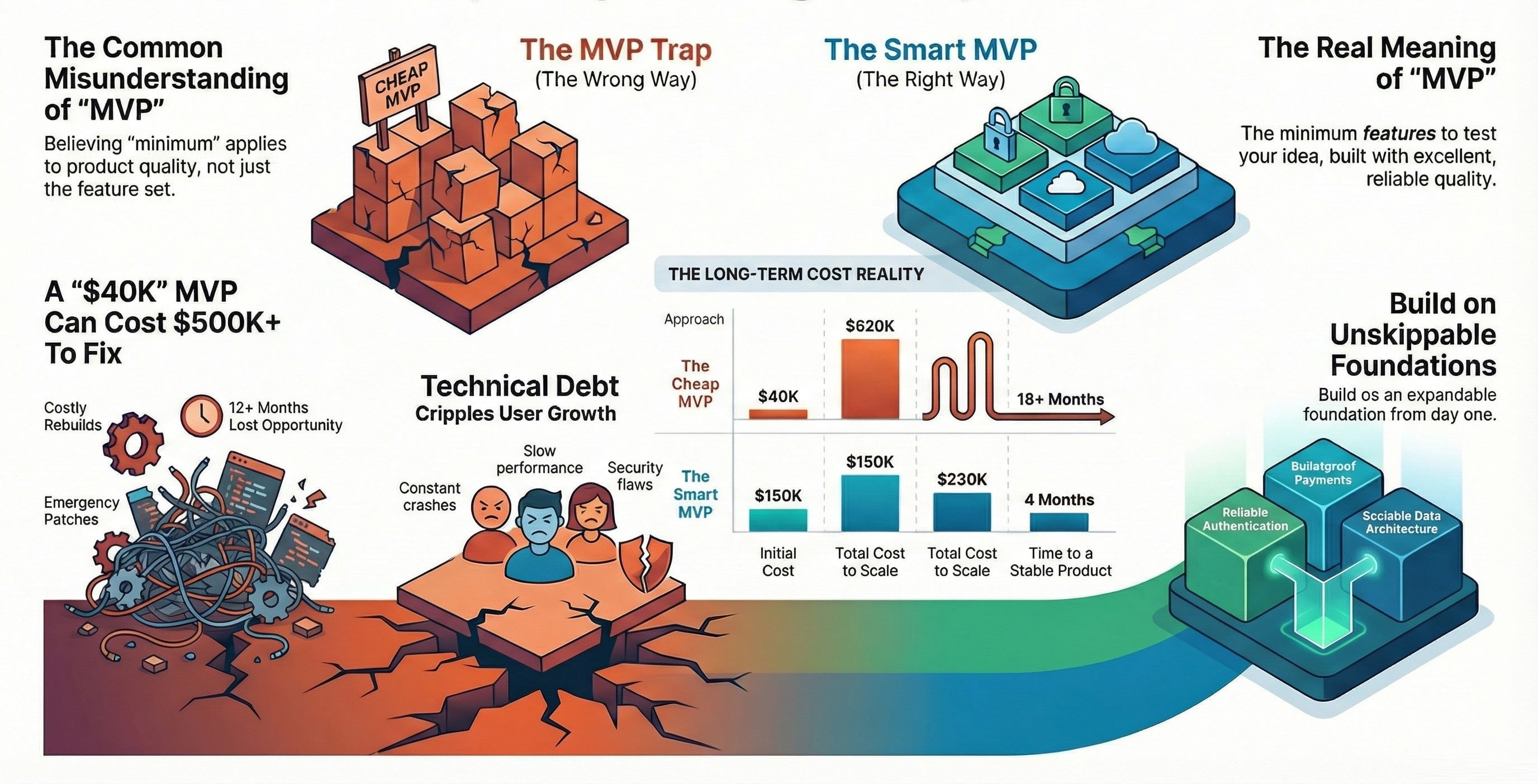
The Dangerous Misunderstanding
"Minimum Viable Product" has been catastrophically misinterpreted.
Most founders think it means: build the absolute cheapest, fastest thing possible. Cut every corner. Launch garbage. Improve it if it works.
Here is what MVP actually means: build the minimum features necessary to test your business hypothesis, but build those features properly.
The "minimum" applies to features, not quality. The "viable" means it actually works reliably.
SWEAT launched with limited features: basic workout tracking, simple social elements, essential content delivery. But those features worked flawlessly. The app handled 20,000 users in week one without breaking. The same architecture scaled them to millions of users globally.
They built lean. They did not build poorly.
Kayla Itsines and Tobi Pearce did that without a technical co-founder. Whether you need one is a separate decision worth making deliberately, and we work through it in do you need a technical co-founder to build an app.
What "Minimum" Actually Means
Strip away features you do not need yet. You probably do not need advanced AI recommendations on day one. You do not need complex gamification systems. You do not need 50 different workout categories.
Start with core value proposition. If you are a fitness app, what is the one thing users absolutely need? Probably: access to quality workouts, ability to track progress, and reliable performance.
Build that superbly. Do not build 20 features poorly. Build 5 features excellently.
Traininpink launched with guided workouts, progress tracking, and community features. That is it. But those features worked beautifully. The app was fast, reliable, and delightful to use. That is why it hit #1 in Italy's app store.
What "Viable" Means
Viable means it actually functions reliably. Not "mostly works". Not "works if users do not stress it too much". Works. Period.
This requires proper foundations even in an MVP.
Authentication that does not lock users out randomly. Payment processing that does not lose transactions. Data storage that does not corrupt. Performance that stays consistent under load. Security that protects user data from day one.
These are not negotiable just because you are building an MVP. They are the difference between viable and broken.
The Foundations You Cannot Skip
We have built 100+ MVPs. We have rescued dozens more from agencies that built without foundations. Here is what you absolutely must get right:
User authentication needs to work reliably. This is not just login and logout. It is password reset flows that do not fail. Session management that does not log people out randomly. Multi-device support that syncs properly. Two-factor authentication for security.
Skimping here means users cannot access your app. No amount of great features matters if people cannot log in.
Payment processing must be bulletproof. Failed payments cost you revenue directly. Duplicate charges destroy trust. Refund complications create support nightmares.
This requires proper integration with payment providers. Proper error handling. Proper receipt generation. Proper subscription management. Not "it works on my test account".
Data architecture has to scale. Your database schema choices on day one affect your performance for years.
Poor schema design means slow queries. Slow queries mean frustrated users. Frustrated users mean bad retention. Fixing database architecture at scale is expensive and risky.
API design matters from the start. Your mobile app talks to your backend through APIs. Poorly designed APIs create performance problems. They make adding features difficult. They create security vulnerabilities.
Changing APIs after launch is complicated, especially once you have mobile apps in users' hands that expect specific API structures.
Code architecture determines maintenance costs. Spaghetti code is cheap initially. Expensive forever. Every feature takes longer. Every change breaks something. Every bug is hard to fix.
Proper code architecture costs more upfront and saves you a great deal more over time.
Security cannot be retrofitted. You are handling user data from day one. Personal information. Payment details. Workout data. Private messages.
A security breach destroys your reputation. And handling user data poorly is illegal in many jurisdictions.
Why Architectural Mistakes Get More Expensive Every Month
The usual way to make this argument is with two columns of numbers. The numbers are less convincing than the mechanism, so here is the mechanism.
A feature bug is contained. An architectural mistake is depended on. If a screen is wrong, you fix the screen. If the database schema is wrong, every feature built on top of it has assumed that shape, every query is written against it, every report reads from it, and every app in a user's hand expects the API that exposes it. The cost of the fix is not the cost of the change. It is the cost of everything that has to change with it.
The dependency count only goes up. On the day you launch, one thing depends on your data model. Six months later, forty things do. The same correction is the same amount of work in the wrong place, multiplied by how much has been built since.
Users turn a change into a migration. Before launch, changing a permissions model is a decision. After launch, it is a decision plus a data migration, a rollback plan, a communications plan and an outage window. The technical work is the smallest part of it.
Mobile releases are not reversible on your schedule. A web platform can ship a fix in an hour. An installed app has versions in the wild you do not control, and a breaking API change has to support both the old and the new client until the old one is gone. That is two implementations of the same thing, maintained in parallel, for as long as it takes.
The team slows down while it is happening. This is the cost nobody forecasts. While the architecture is being corrected, feature work stops or slows to a crawl. The lost months are not on any invoice, and they are frequently the most expensive part.
Put those five together and you have the shape of the whole thing. The cheap MVP does not cost less. It defers the cost to the point in the timeline where it is hardest to pay, which is precisely the moment you have succeeded enough to have users you cannot afford to lose.
Two Paths, Same Product
Path A, the cheap MVP. Built fast on whatever was easiest. Launches with bugs. Crashes under load. Handles perhaps a thousand concurrent users before breaking. Adding features takes longer every month because the code is messy. Needs a complete rebuild at ten thousand users. Time to a genuinely stable product: eighteen months or more. User experience for most of the first year: poor.
Path B, the smart MVP. Built properly on foundations that were designed for load. Launches stable. Handles fifty thousand concurrent users. Adding features stays efficient because the code is clean. Scales smoothly without major architectural changes. Time to a stable product: the day it launches. User experience: excellent from day one.
Path B costs more at the start. It costs substantially less by the end, and it does not spend a year of your market window apologising to users.
The Features You Can Skip (Initially)
Building a smart MVP means ruthlessly prioritising. Here is what you can defer:
Advanced analytics and reporting. Basic metrics (users, revenue, retention) matter. Detailed cohort analysis and complex dashboards can wait. Build comprehensive analytics after you have validated the core business model.
Sophisticated social features. Basic profiles and following might be essential. Advanced features like group challenges, leaderboards, and detailed activity feeds can come later, once you understand how your community actually wants to interact.
Complex content management systems. Initially, you might upload content manually. Once you validate that users want your content, build efficient CMS tools. Do not over-engineer content infrastructure before proving your content works.
Extensive customisation options. Start with one approach that works well. Add personalisation and customisation after understanding user preferences. Instagram did not launch with filters.
Multiple integration partners. Pick one or two essential integrations (payment processing, email delivery). Add more once you have proven core value. Each integration adds complexity.
Advanced gamification systems. Points, badges, and elaborate achievement systems can wait. Focus on core engagement mechanics first. Add gamification once you understand what drives your users.
The Features You Cannot Skip
Some things need to work properly from day one:
Core user flows must be excellent. The critical path from signup to experiencing value must be smooth. If you are a fitness app, the flow from "I want to work out" to "I am working out" needs to be frictionless.
Performance has to be solid. Users will not tolerate a slow app. Period. Three-second load time and you have lost them. This requires proper optimisation from day one.
Error handling needs to work. Things will go wrong. How your app handles errors determines user frustration levels. Good error messages. Graceful failures. Recovery mechanisms.
Essential security measures. User authentication. Data encryption. Payment security. Privacy compliance. These protect both your users and your business.
Basic analytics for decision-making. You need to understand what users do. What features they use. Where they drop off. What causes problems. You cannot improve what you do not measure.
The QuickLaunch Approach to MVPs
Our approach delivers both speed and quality.
We use proven components for infrastructure. Authentication, payments, data storage, content delivery: these are solved problems. Use battle-tested solutions. Do not rebuild from scratch.
We build custom for differentiation. Your unique features, your brand, your user experience are fully custom. This is where we invest design and development time.
We architect for scale but build for today. The architecture can handle millions of users. But we only build the infrastructure you need now. This balances future scalability with current cost-efficiency.
We prioritise ruthlessly. Every feature must justify its inclusion. If it is not essential for initial validation, it waits. This keeps scope tight and quality high.
We launch fast but stable. Four to six months to market with a properly built MVP. Fast enough to capture market opportunity. Slow enough to build right.
Real MVP Success Stories
SWEAT launched with basic workout tracking, simple social features, and content delivery. Nothing fancy. But it worked brilliantly. They acquired 20,000 users in week one. Those users had an excellent experience. The app scaled smoothly to millions of users over seven years and never needed an architectural rebuild. It was acquired for $400M, and the platform passed Big 4 due diligence at exit on the same core architecture it launched on.
Traininpink started with guided workouts and community features. A limited content library initially. But the app was fast, beautiful, and reliable. Users loved it. It hit #1 in the Italian app store within six months, and it got there without a rebuild and without accumulating technical debt on the way.
EzLicence launched with a basic booking flow and instructor management. Simple but solid. It handled its initial market, then scaled to facilitate $100M+ in annual bookings on the same core architecture. No major technical changes were required to get there.
The pattern across all three is the one worth noticing. None of them launched with many features. All three launched on foundations that never had to be replaced.
The Questions Founders Ask
"Cannot we just fix problems after launch?"
Some problems, yes. Architectural problems, no. Database schema, API design and code architecture become exponentially more expensive to fix after launch, for the five reasons set out above. Especially once you have users.
"Will not building properly take too long?"
Our MVPs launch in four to six months. That is faster than competitors who then spend another six to twelve months fixing their poorly built MVPs. You will be iterating on features while they are fighting fires.
"Is it worth the extra cost?"
The cheap approach costs more overall. Add the opportunity cost of a poor user experience, the reputational damage and the lost users, and the proper approach is cheaper on any honest accounting.
The Pivot Consideration
"But what if we pivot? Will not we have wasted money building properly?"
Fair question. Here is the reality: proper architecture makes pivoting easier, not harder.
Clean code is easier to modify. Scalable infrastructure adapts to new use cases. Quality components can be repurposed. Good data architecture supports different features.
Spaghetti code makes pivoting nearly impossible. You cannot modify what you cannot understand. You cannot repurpose components that barely work for their original purpose.
Every successful pivot we have seen happened on solid technical foundations. Poor technical foundations usually die before getting a chance to pivot.
The Alternative Path
Imagine launching your MVP in six months. It works beautifully. Users have an excellent experience. No crashes. No slowness. No broken features.
You acquire your first 100 users. The app handles them effortlessly. You get to 1,000 users. Still running smoothly. You hit 10,000 users. No architectural changes needed. The same foundations that launched your first user now serve your ten thousandth.
You are focusing entirely on product-market fit. On user feedback. On content quality. On marketing effectiveness.
You are not dealing with technical fires. Not explaining to users why the app crashed again. Not spending emergency budgets on patches.
That is what building properly from day one enables.
The Reality Check
Building a proper MVP is not magical. It does not guarantee success. Plenty of well-built MVPs fail because of market problems, not technical problems.
But here is what it does guarantee: technical quality will not be why you fail. Poor architecture will not limit your growth. Infrastructure will not distract you from finding product-market fit.
You get to focus on the hard problems, which are understanding your users, creating value and building a business. Not fighting technical debt.
Your Next Decision
You are facing a critical choice. Build cheap and hope to fix problems later, or build properly and scale smoothly.
The cheap path seems attractive initially. Lower cost. Faster launch. Every corner-cutting agency will promise you this path.
The proper path requires more initial investment. It takes slightly longer. It requires the discipline to say no to non-essential features.
But here is what we know from 100+ projects: the proper path costs less overall. It gets you to scale faster. It produces better user experiences. It reduces stress dramatically.
Every successful app we have built took the proper path. Every rescue project we have taken over came from the cheap path.
The choice seems obvious when you see the full picture.
We have helped 100+ founders build MVPs that actually scale. Not MVPs that need rebuilding. Not MVPs that collapse under success.
If you are ready to build properly from day one, we should talk.
Because the minimum your product needs is maximum foundations.