PRASA has three functions - to regulate, to support and to advise - and each speaks to a different need on the same site. A pharmacist buying a practice, a provider relocating premises or adding a consultation room, and a company changing its directors or shareholders all arrive looking for one specific obligation and one specific form. A regulator's website fails not by looking dated but by making a requirement hard to find, because the consequence is a non-compliant application or a phone call that should not have been necessary.
Pharmacy Regulation Authority SA
A regulator's website where finding the right form is the whole job.
Regulate, support, advise
The Pharmacy Regulation Authority South Australia regulates pharmacy ownership and operation across the state. Its website is not a marketing asset - it is where pharmacists and pharmacy services providers go to understand their obligations and to lodge the applications that keep them compliant. PixelForce built it on Craft CMS around that single job.
Platform Craft CMS
Application set 4 core forms
Audience Pharmacists and providers
The Problem
The Solution
PixelForce built the site on Craft CMS, with the information architecture organised around the actions a pharmacy services provider actually needs to take rather than around the Authority's internal structure. Codes and guidelines, the application set for alteration, relocation, sale, purchase and change of provider, the fee schedule and the resources and news feed each have a clear route in, and the Authority's own team maintains all of it.
The Outcome
The site now presents PRASA's regulatory material and its full application set in one place, alongside information about the Authority itself and the members appointed to it. Because it is content-managed, the Authority publishes new codes, guidelines, fee schedules and notices directly - which matters for a regulator, where the published version is the operative one and a delay in publishing is a compliance problem rather than an inconvenience.
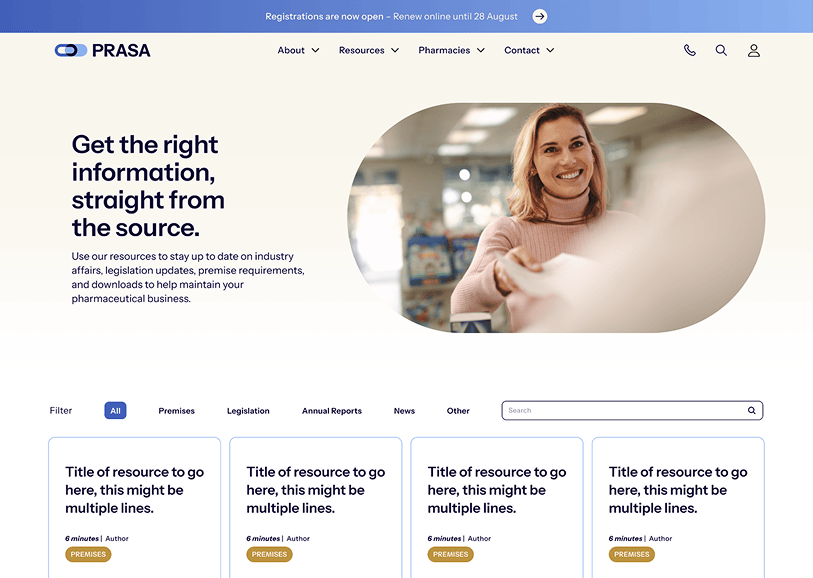
What a regulator's website is for
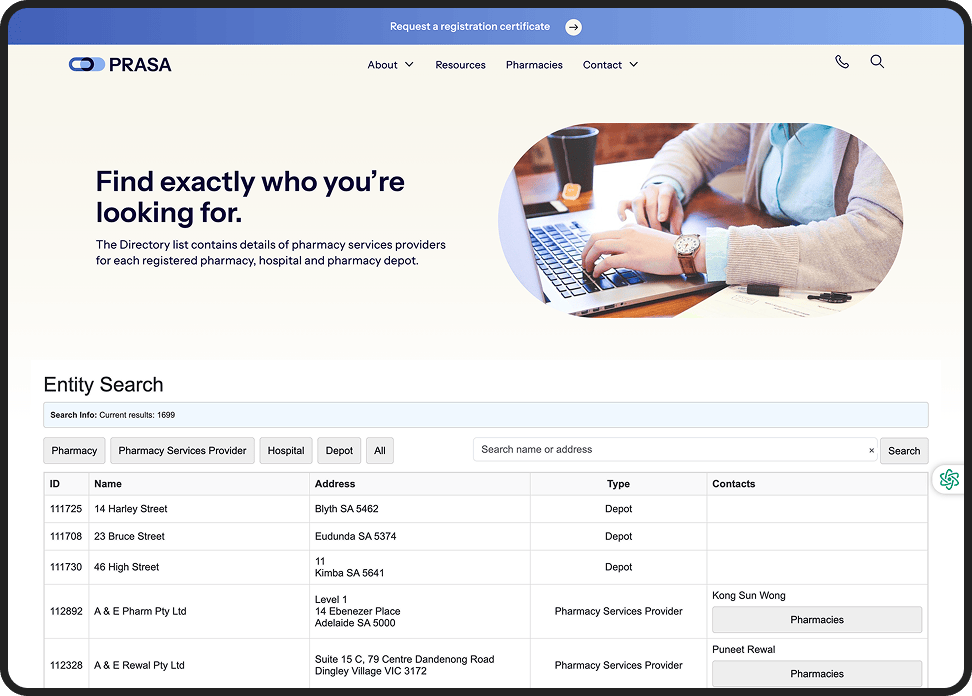
The Pharmacy Regulation Authority South Australia is the statutory body overseeing pharmacy ownership, control and operational standards in the state. The Authority is made up of members appointed by the Governor on nomination by the Minister for Health and Wellbeing, and it exists to safeguard the public by keeping pharmacy business operations legal, ethical and health-focused. It describes its work in three parts: regulating pharmacy ownership and standards, supporting pharmacists and pharmacy service providers, and providing independent advice on safe and ethical practice.
Its website therefore carries a specific and largely transactional load. Pharmacists and pharmacy services providers come to it to check a regulatory requirement, download the correct application, understand a fee, request a registration certificate or lodge a complaint. Everything about the site's usefulness depends on whether somebody with a particular obligation can find the material that governs it and the form that satisfies it. PixelForce was engaged to build that site, with the Authority able to keep its own regulatory content current.
Three functions, one site
PRASA regulates, supports and advises. Each function speaks to a different need, and all three had to be legible from the same homepage.
Finding the form is the task
Most visits exist to satisfy a specific obligation. If the right application is hard to locate, the site has failed regardless of how it looks.
The published version is operative
For a regulator, publishing is not marketing. A delay in getting a changed requirement online is a compliance problem, so the Authority had to publish directly.
Accessible by obligation
Regulatory material has to be usable by everyone bound by it, which made accessibility a constraint on the design rather than a later audit.



Both PRASA and PixelForce are South Australian, and the engagement ran directly with the Authority's team. Regulatory content carries a different review standard to marketing copy - wording has legal weight and cannot be improved for style - so the process kept content authority firmly with PRASA while PixelForce owned structure, presentation and delivery. That division was set at the start rather than negotiated during the build.
Hinney Lo Founder & CEO, PixelForce
On a regulator's site, design quality is measured by how quickly somebody finds the obligation that applies to them. Nobody visits to admire it. They visit because they have a form to lodge and a rule to satisfy.


Swipe to explore
How it was built
Scoping and design came first, and for a regulator the substance of that stage is the information architecture. The organising decision was to structure the site around user actions rather than around the Authority's own divisions: a provider does not think in terms of governance functions, they think "I am relocating my pharmacy" or "I am changing a shareholder". Codes and guidelines sit as reference material, and the application set - pharmacy alteration and relocation, sale or purchase and change of ownership, registration of a new pharmacy or provider, and changes to directors, shareholders, trustees, beneficiaries or partners - is reachable directly.
The build uses Craft CMS, chosen because a regulator publishes continuously and cannot wait on a development cycle to do it. Codes, guidelines, fee schedules, resources and news items are all content-managed, so when a requirement changes the Authority publishes the change itself. Structured content types keep the growing library of regulatory material consistent as it accumulates, instead of leaving each new document to be laid out by hand.
Two things were treated as requirements rather than refinements. The first is accessibility: a public body's regulatory material has to be usable by everyone who is bound by it, which constrains contrast, type and structure. The second is that the site had to work properly on a phone, because a pharmacist checking an obligation is frequently doing it from the dispensary rather than from a desk. The result is a responsive site that presents dense regulatory content clearly at any width.
Published by the Authority
Content-managed on Craft CMS.
When a requirement changes, the regulator publishes it - not a developer.
- Information architecture
- Codes and guidelines
- Applications and forms
- Resources and news
- About the Authority
- Accessibility
01 06
Information architecture
The site is organised around what a provider is trying to do - relocate premises, sell or buy a pharmacy, register a new provider, change a shareholder - rather than around the Authority's internal divisions. That UX decision is the difference between a site somebody can use and a site somebody has to be guided through.
02 06
Codes and guidelines
PRASA's regulatory requirements and expectations are presented as structured, content-managed reference material, so the library stays consistent in format as it grows and each new document does not need to be laid out individually.
03 06
Applications and forms
The four core application types are reachable directly from the homepage: pharmacy alteration and relocation including consultation rooms and secure collection units, pharmacy sale or purchase and change of ownership, registration of a new pharmacy or services provider, and changes to directors, shareholders, trustees, beneficiaries or partners.
04 06
Resources and news
A managed feed for the Authority's updates, resources and notices, so guidance reaches pharmacists, providers and the public without a development cycle in between.
05 06
About the Authority
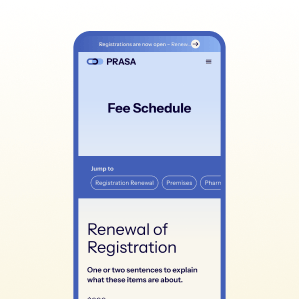
Material on the Authority itself, its appointed members, the team, the fee schedule and its privacy terms - the governance transparency expected of a statutory body.
06 06
Accessibility
Contrast, type and document structure were set so the site meets the accessibility expectations of a public body. Regulatory content binds everyone, so it has to be readable by everyone.
Services in the PRASA website build
Frequently Asked Questions
The Pharmacy Regulation Authority South Australia website at pharmacyauthority.sa.gov.au, built on Craft CMS. It presents the Authority's codes and guidelines, its four core application types, the fee schedule, a resources and news feed, information about the Authority and its appointed members, and direct routes to request a registration certificate or make a complaint.
Because a regulator publishes continuously and the published version is the operative one. Craft CMS gives the Authority direct control over codes, guidelines, fee schedules and notices, with structured content types that keep a growing regulatory library consistent. Waiting on a development cycle to publish a changed requirement is not acceptable for a body with statutory obligations.
Yes. That was the central requirement. Codes, guidelines, fee schedules, resources and news are all content-managed by the Authority's own team, so a change in requirement reaches the public without developer involvement.
Yes. PixelForce has delivered work for South Australian and national public sector organisations, and this project is a statutory authority build. Public sector work brings specific constraints - accessibility obligations, governance transparency and content wording that carries legal weight - which shape the process rather than sitting on top of it.
By organising it around the user's action rather than the organisation's structure. A provider thinks "I am relocating my pharmacy", not "I need the regulatory oversight division". The information architecture maps to those actions, and the reference material sits behind them for anyone who needs the detail.
Both were treated as requirements. Contrast, type and structure were set against the accessibility expectations of a public body, and the site is fully responsive because pharmacists frequently check an obligation from the dispensary rather than from a desk.
Up next
More products we have designed, built and launched end to end.

EzLicence UK From Australia to the United Kingdom
Taking a proven driving-lesson marketplace from Australia to the UK, localised for a new market from day one.

Pilates Obsession From Studio to Global Platform
How we turned Sara Colquhoun's studio expertise into a global Pilates platform in three months