
Crop Shop Boutique
Automated order tracking · e-commerce
100%pre-shipment notifications automated
2 wksdevelopment cycle
PixelForce is an AI app development company that builds custom AI solutions into products people already use. We ship intelligent features on production infrastructure - knowledge systems, OCR claiming flows, recommendation and prediction - from a 100% in-house Adelaide team.
Most AI projects die between the demo and the release. The three below did not, and they are the reason PixelForce can describe itself as an AI app development company rather than a team that has read about one. EzLicence asked us for an AI knowledge system and got The Handbook shipped in 4 weeks: it consolidated seven years of product evolution, delivers a 50 percent efficiency gain across workflows, and automates 90 percent of documentation updates with 10 percent human oversight. OpBill needed medical billing to stop being a data-entry job, so we built an AI-powered OCR claiming flow - Snap, Scroll, Done - that made billing 90 percent faster with 98 percent user satisfaction, built in 4 months. Crop Shop Boutique connected ShipBob, Klaviyo and Shopify in a 2-week development cycle, automating 100 percent of pre-shipment customer notifications and eliminating the manual CSV export workflow. Three different problems, one shared pattern: a narrow, well-chosen capability wired into a system people already depend on, with a human in the loop wherever a wrong answer would cost something. Custom AI development is far less about the model than teams expect and far more about the data feeding it, the evaluation proving it works, and the fallback for the day it does not.

AI knowledge system · The Handbook
AI-powered OCR claiming · medical billing
Automated order tracking · e-commerce
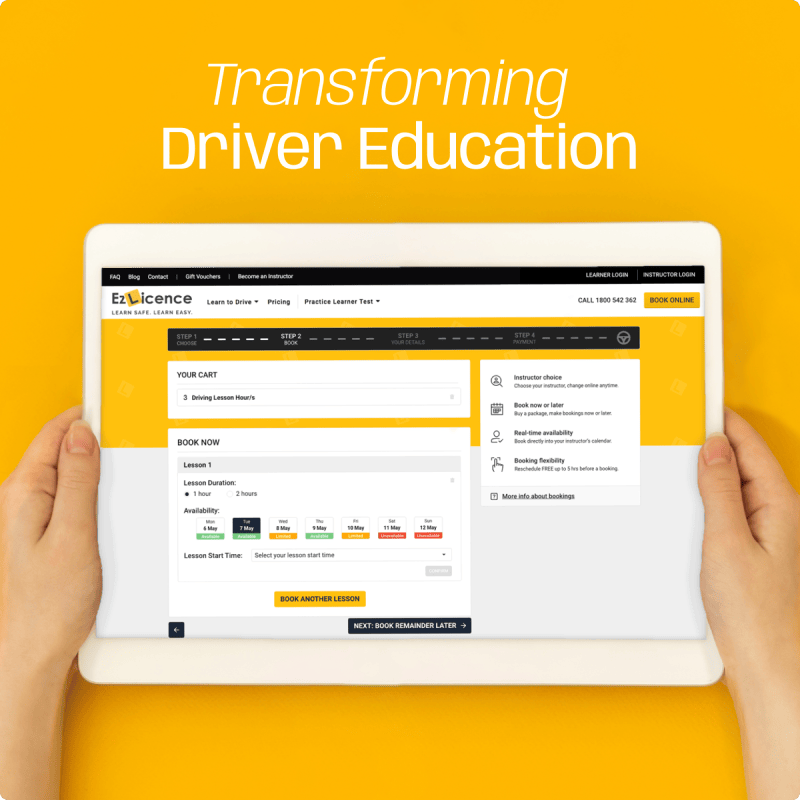
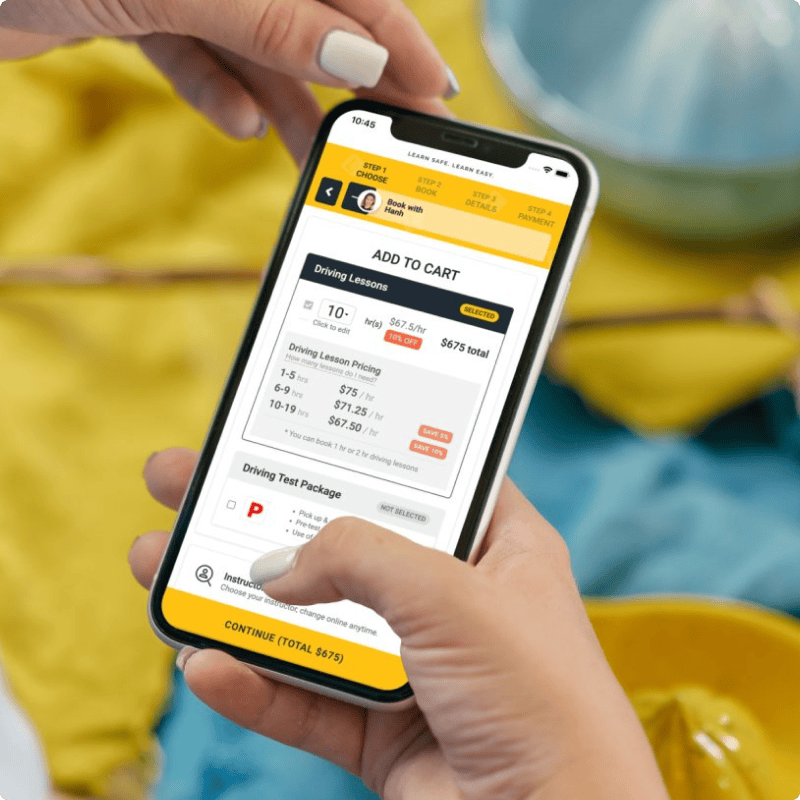
EzLicence runs a marketplace that processes $100M+ in annual bookings with 1,000 verified instructors, and seven years of product evolution had accumulated in the heads of the people who lived through it. We shipped an AI knowledge system - The Handbook - in 4 weeks. It consolidated that history into something answerable, delivers a 50 percent efficiency gain across workflows, and automates 90 percent of documentation updates with 10 percent human oversight. The 10 percent is the part worth dwelling on. It was a deliberate design decision rather than a limitation we ran into, because a knowledge system that is confidently wrong is worse than no knowledge system at all. Choosing where a human stays in the loop, and building the interface so that oversight takes seconds rather than minutes, is most of what separates AI that gets adopted from AI that gets switched off in month two. This is what custom AI development looks like when it is scoped against an actual operational cost rather than a technology roadmap.
Independent recognition for the team behind EzLicence, OpBill, SWEAT and SuspectED - Apple Best of Developers, Watch and TV App of the Year, and Top Clutch App Development and Software Development Company in Australia 2026. PixelForce is an AWS Advanced Tier Partner with 15+ AWS-accredited engineers, holding a 99.99 percent uptime rate and a 98 percent first-time app store approval rate across 100+ shipped products. None of those awards were given for AI, and that is rather the point. An AI feature is a product feature: it has to be designed, tested, released, monitored and supported like everything else in the app. The teams that struggle with AI in production are usually not struggling with the model, they are struggling with the deployment pipeline, the evaluation harness, the cost of inference at real volume, and the question of who owns it at 2am. Choosing an AI development company on machine learning credentials alone, without asking what they have actually shipped and still operate, is how organisations end up with an impressive prototype and nothing in the store.




There is no shortage of firms offering custom AI solutions right now, and a good number of them started offering them the same year you started asking. Four reasons product teams, founders and operations leaders pick PixelForce as their AI software development company instead. We are an AI company in Australia with a 100% in-house team and an Adelaide headquarters, not a reseller layer in front of somebody else's engineers. The through-line is that we were a product engineering company for over a decade before AI became the thing everybody sells, so the AI work sits on top of the boring competencies that decide whether it survives contact with real users - architecture, data, QA, release engineering, monitoring and support. We will also tell you when the answer is not AI, which is more often than the market currently admits, and that conversation happens before an invoice rather than after one.
The first question is never which model to use. It is which decision inside your product is currently made slowly, manually or badly, what a better version of that decision would be worth, and whether a model is the cheapest way to get it. Sometimes a well-designed rule or a better-structured database beats a model at a tenth of the cost and none of the ongoing evaluation burden, and we will tell you that. Phase 1 Scoping & Design runs two strategic workshops to separate the AI features that would create genuine advantage from the ones that would only create a maintenance obligation, and the 1-3-1 method frames every trade-off: one problem, three options with their consequences, one recommendation.
A working demo and a production AI feature are separated by evaluation harnesses, confidence thresholds, fallback paths, rate limiting, cost controls, logging and monitoring - none of which are interesting and all of which decide whether the thing is still running next year. PixelForce is an AWS Advanced Tier Partner with 15+ AWS-accredited engineers and holds a 99.99 percent uptime rate across 100+ shipped products. Your AI infrastructure runs on your own cloud account with the IP transferring to you, so you are never renting access to your own product. This is the discipline that took OpBill from concept to a claiming flow real clinicians use, built in 4 months.
The people who scope your AI features are the people who design them, build them and ship them. PixelForce runs 100% in-house development from an Adelaide headquarters, so there is no subcontracting chain between the conversation and the code and no offshore layer handling your data. That matters more on AI work than on almost anything else, because the decisions that determine whether a feature is trustworthy - what the model sees, what gets redacted, where the confidence threshold sits, who reviews an uncertain result - are made in small conversations that need to happen the same day. Cadence is fixed and visible: squad sessions every 2 weeks and planning every 4 weeks, with sprint demos you attend.
We never scope something a client cannot afford to build, and budget alignment happens at the first consultation rather than after a proposal lands. With AI that honesty has a specific shape. If your data is not ready, we will say the first project is a data project. If an existing hosted model would do the job, we will not sell you a custom one. If the feature you are describing would be genuinely useful but would also need permanent human review to be safe, we will price that in rather than leave you to discover it. Declining a project, or recommending against building, is a valid outcome here, and across 100+ shipped products that consequence-awareness has been worth more to clients than enthusiasm.
Six AI development services we have shipped repeatedly, from the assessment that decides whether to build at all through to the evaluation and monitoring that keeps a live model honest. AI software development is ordinary product engineering carrying an unusually sharp dependency on data quality, which is why the sequence below matters more than the toolkit does. Take one, or combine them into a single engagement scoped in Phase 1. Two adjacent clusters live on their own pages: if the outcome you want is a business process running itself rather than a feature your customers touch, that is AI agents and automation, and if you are validating a brand new AI product rather than adding intelligence to an existing one, start with AI MVP and rapid prototyping. If your question is the other one - not what AI we can build into your product, but how we use AI to build it - that is AI software engineering.
Phase 1 Scoping & Design, applied to AI. We map where a model would create measurable advantage, test technical feasibility against your actual data rather than an idealised version of it, and produce a Business Requirements Document, a Product Requirements Document and a fixed-cost Statement of Work for the build. The data readiness review is the part that saves the most money: it is common to find that the first useful project is not an AI project at all but the work of getting your data into one consistent, queryable place. Better to learn that in a workshop than in month three of a build. No Blueprint, no Build.
The core of custom AI development: wiring a capable model into your product so that it behaves like a feature rather than a science experiment. Prompt and retrieval design, structured output that your application can actually rely on, streaming interfaces, caching, cost controls and graceful degradation when a provider is slow or unavailable. We stay technology-agnostic across hosted and open-weight models because the sensible choice changes every few months. Where your requirement is specifically about grounding a model in your own document corpus, our generative AI and LLM development page covers that ground in more depth.
Machine learning app development for the problems that are genuinely predictive rather than conversational: recommendation and ranking, churn and engagement prediction, quality scoring, matching, anomaly and fraud signals. We have built and tuned recommendation systems for fitness apps, e-commerce and two-sided marketplaces, where the quality of the match is the whole business model. These systems are built to start modest and improve as behavioural data accumulates, because waiting until you have a large dataset to ship anything is how teams end up with neither the dataset nor the feature.
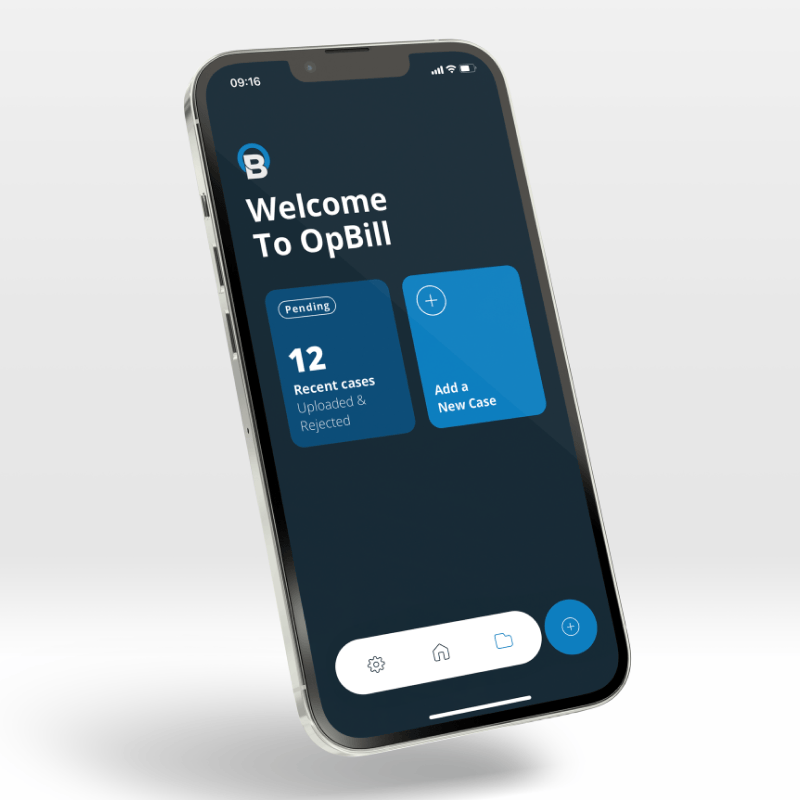
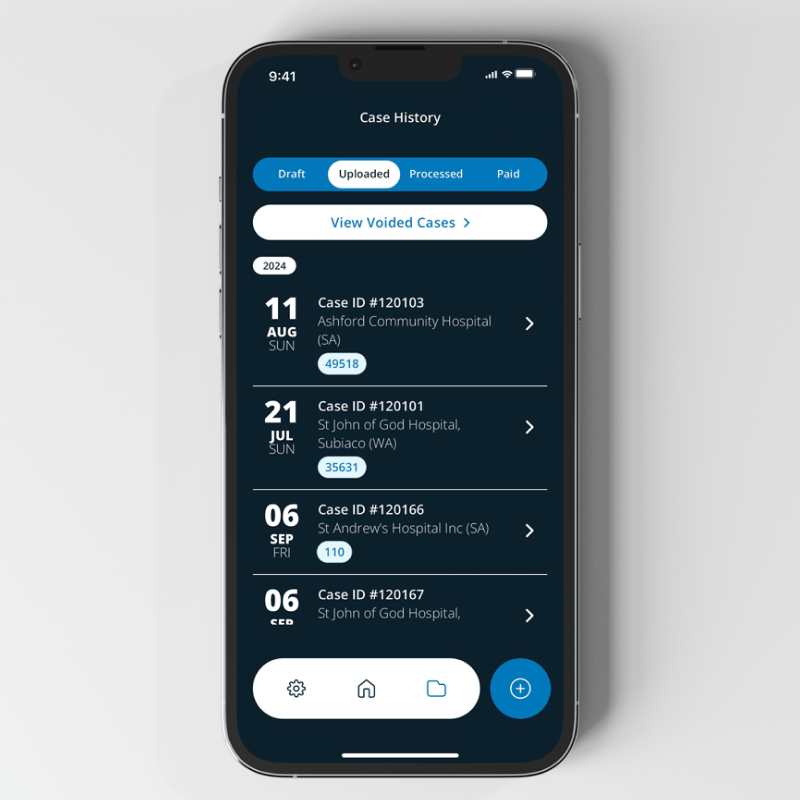
Computer vision app development for the cases where the input is an image or a document rather than a form. Extraction, classification, verification and on-device processing where latency or privacy requires it. OpBill is the reference build: an AI-powered OCR claiming flow branded Snap, Scroll, Done that made medical billing 90 percent faster with 98 percent user satisfaction, built in 4 months. What made it work was not the recognition accuracy in isolation but the interaction design around it - how a clinician corrects a misread field in one tap, and how the system learns which fields it is routinely getting wrong.
AI integration services for products that already have users, revenue and momentum, all of which are expensive to interrupt. Rather than rebuilding, we audit the existing architecture, map where your data lives and how much it can be trusted, and identify the single highest-impact feature to ship first. Intelligent search over your own content, personalised recommendations, automated classification and moderation, or a natural language interface over data that currently requires a report. EzLicence is the pattern: we added an AI knowledge system alongside a marketplace processing $100M+ in annual bookings rather than touching the marketplace itself.
The layer that decides whether an AI feature is still trustworthy in twelve months. Evaluation sets built from your real edge cases, accuracy tracked by user segment rather than in aggregate, drift and latency monitoring, cost per request visible before it becomes a surprise, and confidence thresholds that escalate an uncertain result to a person instead of presenting it as fact. It runs on your own cloud account with CI/CD, staging and alerting. Model and inference charges are billed to your accounts and change frequently, so check each provider's current pricing page rather than trusting a number in a proposal.
OpBill's AI-powered OCR claiming flow - Snap, Scroll, Done - made medical billing 90 percent faster with 98 percent user satisfaction, built in 4 months. Medical billing is an unglamorous, high-consequence problem: the input is a photograph of a document, the output goes to a claims system, and a mistake costs somebody money and somebody else an afternoon. That combination is exactly where computer vision app development earns its keep, and it is also exactly where a proof of concept usually stalls, because recognising text on a good day is easy and being right often enough to be trusted is not. The 98 percent satisfaction figure is the one we would point at rather than any accuracy number, because it measures the whole experience: how fast the scan is, how obvious a misread field is, and how few taps it takes to fix. AI features are adopted or abandoned on that, not on the model. If you are comparing AI app development companies, ask each of them what happens in their product when the model is wrong.
Three engagement models, in the order they normally run. Scope is what drives everything below, which is exactly why Scoping & Design comes first and why no development commitment is made without it. AI app development cost is driven by two things more than any other: how ready your data is, and whether an existing hosted model will do the job or something has to be trained. A team with clean data and a hosted-model feature has far less to build than a team with data spread across three legacy systems and a genuine need for a custom model, and most of the difference is the data work rather than the AI work. Model and inference charges from OpenAI, Anthropic, Google, AWS and others are billed to your own provider accounts, sit outside this scope, and change often enough that publishing them here would mislead you - check each provider's current pricing page.
The mandatory first phase of every build, and a standalone commitment. Preliminaries and two strategic workshops produce the Business Requirements Document, a complete enterprise-grade UX/UI design covering every consumer screen and the key admin screens, a Product Requirements Document, and a fixed-cost Statement of Work for the build. On AI engagements it also carries the data readiness review and the feasibility work that decides whether a hosted model, a custom model or no model at all is the right answer. You can stop here if the evidence says stop, and some clients do. No Blueprint, no Build.
Development, QA and release against the signed Statement of Work: foundation and authentication, backend services and cloud infrastructure, the data pipeline feeding the model, the AI features themselves with their evaluation harness and fallback paths, the app build across iOS, Android and any admin portal, internal QA against the PRD acceptance criteria, client User Acceptance Testing, then submission and launch. How much goes into version one is a recommendation rather than a fixed rule. Even with a larger budget we will usually advise holding version one to a tight scope and spending the remainder on evidence-led iteration afterwards, which matters more on AI work than anywhere else: the first release is where you find out what your users will actually accept from a model, and no amount of pre-launch design settles that question.
Two ways to engage after launch. Option 1, Warranty, Monitoring & Support, covers the critical-bug warranty, 24/7 infrastructure monitoring, business-hours incident response and a monthly Platform Health Report, with technical support capped at seven hours per month. Option 2, the Product Retainer, includes everything in Option 1 and adds a roadmap workshop in month one, continuous sprints shipping designed features into production, and quarterly business reviews. It runs per four-week cycle against a committed story-point capacity, across tiers from Steady through to Momentum, with Enterprise on application. Most AI products belong on the retainer, because a model nobody re-evaluates degrades quietly while every dashboard stays green.
Six layers that appear in nearly every AI build we ship, whatever the model underneath. This is the part worth scrutinising when you compare AI app development companies, because the demo is never the hard bit. Whether the feature is still trusted in twelve months is decided by the data pipeline feeding it, the evaluation proving it works, the interface that makes a wrong answer cheap to correct, and the monitoring that notices when the world has moved.
Almost every disappointing AI project is a data project that was mislabelled. Before a model sees anything, the data has to be reachable, consistent and trustworthy, and that work is usually the largest single line in the build.
A model is not finished when it produces output. It is finished when you can demonstrate how often the output is right, where it fails, and what happens then. Aggregate accuracy on a held-out set is frequently misleading, so we measure by segment.
Not every prediction deserves equal trust. Uncertain results escalate to a person or fall back to simpler deterministic logic rather than being presented as fact. EzLicence runs at 90 percent automation with 10 percent human oversight by design.
Adoption is won or lost here. Users forgive a model that is occasionally wrong if correcting it is obvious and instant, and abandon one that is usually right if fixing the exception is painful. OpBill's 98 percent satisfaction came from this layer.
A model correct at launch is not automatically correct six months later, and inference costs scale with success in a way most budgets do not anticipate. Both need to be visible on a dashboard from day one rather than discovered in an invoice.
What leaves your environment, where it goes and what the provider does with it are architecture decisions, not settings. In regulated settings every AI-influenced decision also needs a record of what the model saw and who reviewed it, and that is impossible to retrofit.
The same canonical PixelForce engagement model behind 100+ shipped products and $1.5B+ in combined client revenue, applied to your AI app. The 1-3-1 method runs through every conversation - one problem, three options with honest trade-offs across budget, timeline and scope, one recommendation. No Blueprint, no Build.
A free, no-obligation conversation to find the right path for your AI app before you commit a dollar.
Everything you need to build with total confidence - a fully costed, designed plan with no scope surprises.
From approved designs to your live AI app, built and tested at a steady sprint cadence.
We do not disappear at launch - monitoring, warranty, and an optional retainer keep your AI app growing.
Selected AI work, built by a 100% in-house Adelaide team you would actually work with on your product. Read these for the decisions rather than the screenshots: what the model was allowed to decide on its own, where a person stayed in the loop, what the fallback was, and how the team knew it was working after launch. Between them they cover the situations we see most often - adding an AI knowledge system alongside a marketplace that could not be interrupted, putting computer vision in front of a high-consequence clinical workflow, and automating an operational process end to end.

ShipBob, Klaviyo and Shopify connected in a two-week development cycle, and a spreadsheet removed from the middle of the customer experience.

An AI knowledge system that consolidated seven years of product evolution, shipped in 4 weeks.
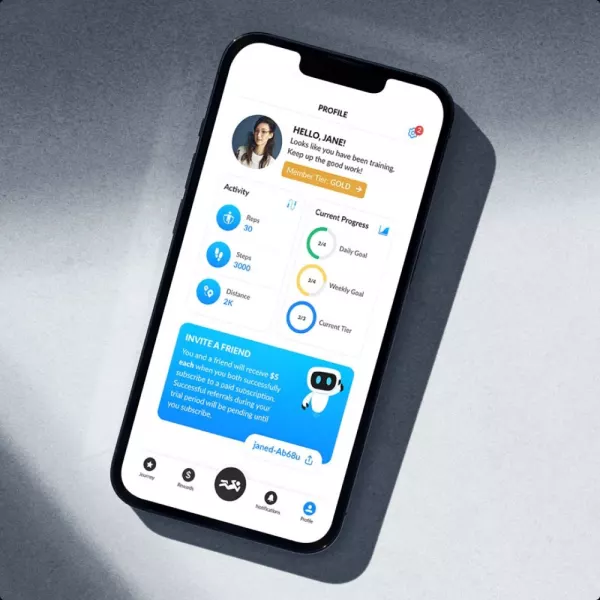
How we built a fitness app that counted every rep from the phone camera and paid people for the work.
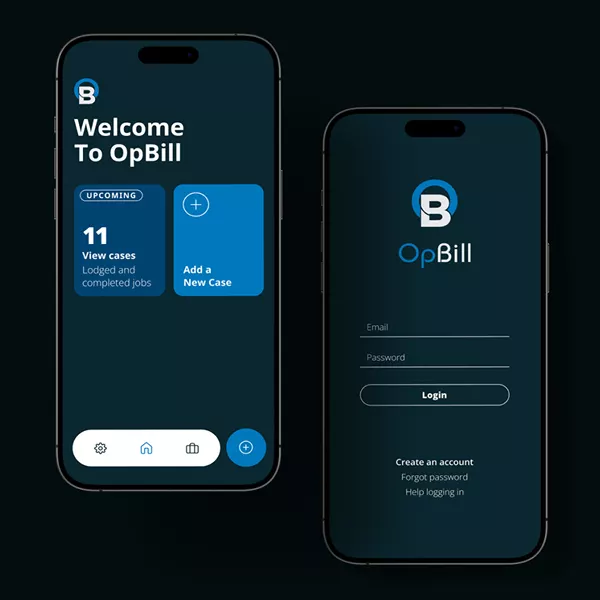
An AI-powered OCR claiming flow that made medical billing 90 percent faster, built in 4 months.
The questions teams ask before committing to an AI build - what AI-powered app development actually means, what it costs, how long it takes, which technologies we use, whether AI can be added to an app that already exists, how accuracy and reliability are handled in production, whether you need your own data, which industries we have shipped into, how AI app development differs from AI automation, whether to use an existing model or train one, and how privacy and compliance are handled. If your question is not here, ask it on a discovery call.
AI-powered app development is building applications that use machine learning, natural language processing, computer vision or other AI techniques to deliver features that improve with usage. A traditional app follows rules somebody wrote down. An AI-powered app learns from behaviour, makes predictions and adapts over time.
At PixelForce we treat AI as a business problem first and a technology second. The first question is never which model to use, it is which decision in your product is currently being made badly, slowly or manually, and whether a model would make it measurably better. Sometimes the answer is that a well-designed rule would do the job for a fraction of the cost, and we will say so.
Where AI does earn its place, the work is ordinary product engineering done carefully - data pipelines, evaluation, confidence thresholds, fallbacks, monitoring and a human in the loop where the cost of a wrong answer is high. We have shipped 100+ products generating $1.5B+ in combined client revenue, and that judgment about what to build is what separates a useful AI feature from a demo.
AI app development at PixelForce is scoped before it is quoted: Phase 1 Scoping and Design first, then Phase 2 Development, QA and Release quoted against the fixed-cost Statement of Work that Phase 1 produces.
We do not quote AI work off a rate card, because the cost is set by scope and by the state of your data. What we can tell you before we look is exactly how the number gets built.
Phase 1 - Scoping & Design is a standalone commitment and it is mandatory before any build: preliminaries, two strategic workshops, a Business Requirements Document, a Product Requirements Document, complete UX/UI design, and a fixed-cost Statement of Work for development. No Blueprint, no Build.
Phase 2 - Development, QA and Release is quoted against that signed SoW, and what moves it is how many AI features are in version one, how much data engineering sits behind them, how many integrations the product carries, and how much regulated or financial logic is involved. Where a budget stretches further than the scope requires, we will usually advise keeping version one tightly scoped and spending the remainder on evidence-led iteration afterwards, because with AI features the first release is where you find out what your users actually accept.
Phase 3 - Post Launch Support has two options. Warranty, Monitoring & Support is a flat monthly fee and covers the critical-bug warranty, 24/7 infrastructure monitoring, business-hours incident response and a monthly Platform Health Report, with technical support capped at seven hours per month. The Product Retainer includes all of that and adds a roadmap workshop, continuous sprints and quarterly business reviews, priced per four-week cycle against a committed story-point capacity, in tiers named Steady, Growth, Scale, Velocity and Momentum, with Enterprise on application. Most AI products belong on the retainer, because a model that is never re-evaluated quietly degrades.
Model and inference charges from providers such as OpenAI, Anthropic, Google and AWS are billed to your own accounts and change often - check the current rates on each provider's pricing page. If you want to test the idea before committing to a full build, our AI MVP and rapid prototyping service is the cheaper way to do it.
How long an AI-powered app takes to build is not knowable before Phase 1 Scoping and Design is complete, and the three variables that move it are data readiness, whether a custom model is needed, and evaluation.
The honest answer is that we will not know until Phase 1 Scoping & Design is done, and any agency that gives you a number before that is guessing. What we can tell you is what moves the number.
Data readiness is almost always the critical path. If your data is clean, well structured and already in one place, the build compresses sharply. If it is scattered across legacy systems, inconsistently labelled or largely unstructured, preparation becomes the project and the model work is the easy part. We assess this during discovery rather than discovering it in month three.
Whether you need a custom model matters more than the app itself. Building on established hosted models is a different order of work to training and validating something on your own data. Most products do not need the second one.
Evaluation takes real time. An AI feature is not finished when it produces output, it is finished when you can demonstrate how often the output is right, what happens when it is wrong, and who catches it. That work is not optional and it is frequently underestimated.
For reference on the achievable end of the range: we shipped EzLicence an AI knowledge system in 4 weeks, and OpBill's AI-powered OCR claiming flow was built in 4 months. Both were narrow by design.
PixelForce stays technology-agnostic on AI, with production experience across hosted and open-weight language models, computer vision and OCR services, recommendation and ranking systems, and managed machine learning infrastructure on AWS and Google Cloud.
We stay technology-agnostic, because the right tool depends on the problem and the landscape changes every few months. Our team has production experience across the major platforms.
We do not have religious preferences about stacks. What matters is a system that works reliably in production, that somebody other than the original author can maintain, and that produces a measurable business outcome.
Yes, AI features can be added to an existing app, and that is usually the smarter move, because a live product already carries users, revenue and operational momentum that are expensive to interrupt.
Yes, and it is usually the smarter move. Many teams treat AI as a reason to rebuild everything. We generally advise against it. Your existing app has users, revenue and operational momentum, all of which are expensive to interrupt and impossible to buy back.
Common integrations we ship into live products include intelligent search over your own content using embeddings and a vector store, personalised recommendations driven by real user behaviour, automated classification and moderation of user-generated content, predictive features that surface a decision before the user has to hunt for it, and natural language interfaces over data that currently requires a report.
The approach is deliberately surgical. During discovery we audit the existing architecture, map where your data actually lives and how trustworthy it is, and identify the highest-impact feature you could ship first. One well-chosen feature in production beats a comprehensive AI roadmap that never ships. EzLicence is the pattern: rather than rebuilding a marketplace that already processes $100M+ in annual bookings, we added an AI knowledge system alongside it in 4 weeks.
PixelForce keeps AI models accurate and reliable in production through five practices: testing against real edge cases, confidence scoring with fallbacks, human oversight sized to the risk, continuous monitoring, and feedback loops from real outcomes.
We treat models like any other production system, with testing, monitoring and safeguards. This is where careful AI implementation separates from the other kind.
Testing and validation. We test against real-world edge cases and measure performance across user segments, not just aggregate accuracy on a held-out set, which is frequently misleading. Knowing where a model fails is more useful than knowing how often it succeeds.
Confidence scoring and fallbacks. Not every prediction deserves equal trust. We implement confidence thresholds so that an uncertain result escalates to a human or falls back to simpler deterministic logic rather than being presented as fact.
Human oversight sized to the risk. The EzLicence knowledge system automates 90 percent of documentation updates with 10 percent human oversight. That ratio was a design decision, not an accident, and it is the kind of decision worth making explicitly at the start.
Continuous monitoring. We track accuracy, drift, latency and error rates in production, because a model that was correct at launch is not automatically correct six months later.
Feedback loops. Real-world outcomes feed back into improvement. When a recommendation is ignored or a classification is corrected, that signal is captured and used.
You do not always need your own data to build an AI-powered app, because pre-trained models already cover chat, content generation, summarisation, extraction and analysis without a single row of your own training data.
It depends entirely on the feature, and for a good number of them the answer is no.
Pre-trained models arrive already trained on an enormous corpus. Chat interfaces, content generation, summarisation, extraction and analysis tools can be built without a single row of your own training data. Most products that describe themselves as AI-powered are in this category.
Recommendation systems benefit from behavioural data but do not require a large dataset to begin. Even modest interaction volume supports a working engine, and we build the architecture so it improves as the data accumulates rather than requiring a rewrite once it does.
Custom models - domain-specific vision, specialised classifiers, anything trained on your particular problem - do generally require proprietary data. We assess the requirement during discovery and plan collection if it is warranted. Very often the right sequence is to start on a pre-trained model, gather data through real usage, and only then evaluate whether a custom model would beat it.
The starting question is always what problem you are solving. Once that is clear, whether you need new data is usually obvious.
We have built AI into products across several sectors, with particular depth in a few.
Health and fitness. Personalised programming, engagement prediction and recommendation at scale. We understand the economics - subscription monetisation, retention as the whole game, and personalisation as the thing that moves it. This is the vertical behind SWEAT, Revia, Fitstop and Traininpink.
Two-sided marketplaces. Matching, fraud signals, quality prediction and operational knowledge systems. AI improves marketplace economics because it improves the quality of the match. EzLicence is the reference build.
Healthcare and regulated industries. OpBill's AI-powered OCR claiming flow made medical billing 90 percent faster with 98 percent user satisfaction. In regulated settings we build for explainability, auditability and human oversight from day one, because retrofitting those is close to impossible.
E-commerce and operations. For Crop Shop Boutique we connected ShipBob, Klaviyo and Shopify in a 2-week development cycle, automating 100 percent of pre-shipment customer notifications and eliminating the manual CSV export workflow.
If your sector is not listed, that is not a barrier. The method does not change: find where a model creates genuine advantage, build it with rigour, and measure the business impact.
AI app development and AI automation solve different problems: AI app development puts intelligence inside a product your customers use, while AI automation removes manual work from a business process that runs behind the scenes.
They solve different problems and they are frequently confused, which leads to teams buying the wrong one.
AI app development means building intelligence into a product that your customers use. The AI is a feature. Someone opens your app, and a recommendation, a search result, a scanned document or a prediction is better than it would otherwise have been. The measure of success is a product metric: retention, conversion, task completion, satisfaction.
AI automation means removing manual work from a business process that runs behind the scenes. Nobody opens an app. A workflow that used to require a person now runs itself, or runs with a person checking it. The measure of success is an operational metric: hours saved, error rate, cost per transaction. That is the territory of our AI agents and automation service.
Plenty of engagements involve both. The EzLicence Handbook is genuinely a hybrid - it is a knowledge system people use directly, and it automates 90 percent of documentation updates with 10 percent human oversight, delivering a 50 percent efficiency gain across workflows. What matters is being clear about which outcome you are buying, because the two are scoped, built and measured differently.
Start with an existing hosted model almost every time, because a custom model is worth considering only where the domain is genuinely narrow, the data is proprietary, unit economics fail, or data residency rules hosted inference out.
Start with an existing model. Almost always.
Hosted models from the major providers are extremely capable, they require no training data, they improve without any effort from you, and they let you have a working feature in front of real users in weeks rather than months. For the large majority of product features - search, extraction, classification, summarisation, conversational interfaces - a well-engineered prompt and retrieval layer over an existing model outperforms what most teams would train themselves, at a fraction of the cost.
A custom model is worth considering when the domain is genuinely narrow and specialised, when you hold proprietary data that no general model has seen, when latency or unit economics at your volume make hosted inference untenable, or when data residency rules out sending the data anywhere. Those are real situations, but they are the minority, and they are much easier to evaluate once a hosted-model version is already running and you have a baseline to beat.
The retrieval-heavy end of this decision - grounding a model in your own documents and data - is covered in more depth on our generative AI and LLM development page. Either way, the recommendation comes out of Phase 1 with the trade-offs written down using the 1-3-1 method: one problem, three options with their consequences, one recommendation across budget, timeline and scope.
PixelForce handles AI data privacy the same way it handles any product carrying sensitive data, with four AI-specific additions: data residency mapping, data minimisation, auditability of every AI-influenced decision, and human oversight.
Data residency and flow. We map exactly what leaves your environment, where it goes, and what the provider does with it. Where data cannot leave a jurisdiction or a boundary, that constraint drives the architecture from the start rather than being patched in later. Infrastructure runs on your own cloud account with the IP transferring to you.
Minimisation. Models receive what they need for the task and nothing else. Redaction and field-level filtering before inference is cheap to build early and expensive to retrofit.
Auditability. In regulated settings every AI-influenced decision needs a record of what the model saw, what it returned, what confidence it carried and who reviewed it. We build that logging as part of the feature.
Human oversight. Where a wrong answer carries real consequence, a person stays in the loop by design. The EzLicence Handbook runs at 90 percent automation with 10 percent human oversight for exactly this reason.
PixelForce is an AWS Advanced Tier Partner with 15+ AWS-accredited engineers, holds a 99.99 percent uptime rate across 100+ shipped products, and develops 100% in-house from an Adelaide headquarters, so there is no subcontracting chain handling your data.
Choose an AI app development company on how it decides what not to build with AI. Ask which decision inside your product is currently made badly, slowly or manually, and whether a well-designed rule would do the same job for a fraction of the cost.
Then look for production evidence rather than demonstrations. Ask to see an AI feature the company shipped that is live now, what accuracy bar it was held to, who judged it, and what happens to the cases that fall short. Ask how confidence thresholds, fallbacks and human oversight were sized, because an AI feature with no fallback path is a demonstration with a login screen.
Check three commercial points. Model and inference charges should be billed to your own provider accounts rather than resold, so ask to see that in writing. Intellectual property and infrastructure should sit with you. And ask what the monitoring looks like six months after launch, because a model that was correct at release is not automatically correct later.
Finally, ask what they would tell you not to build. A company that has never recommended against an AI feature has probably never evaluated one properly.
Book a free consultation and we will work through where AI creates a measurable advantage in your product and where it would only add cost. You will get a straight read on data readiness, on whether an existing model will do the job, and on what Phase 1 Scoping & Design would need to settle before anyone quotes a build. If the honest answer is that you do not need AI yet, we will say so.


