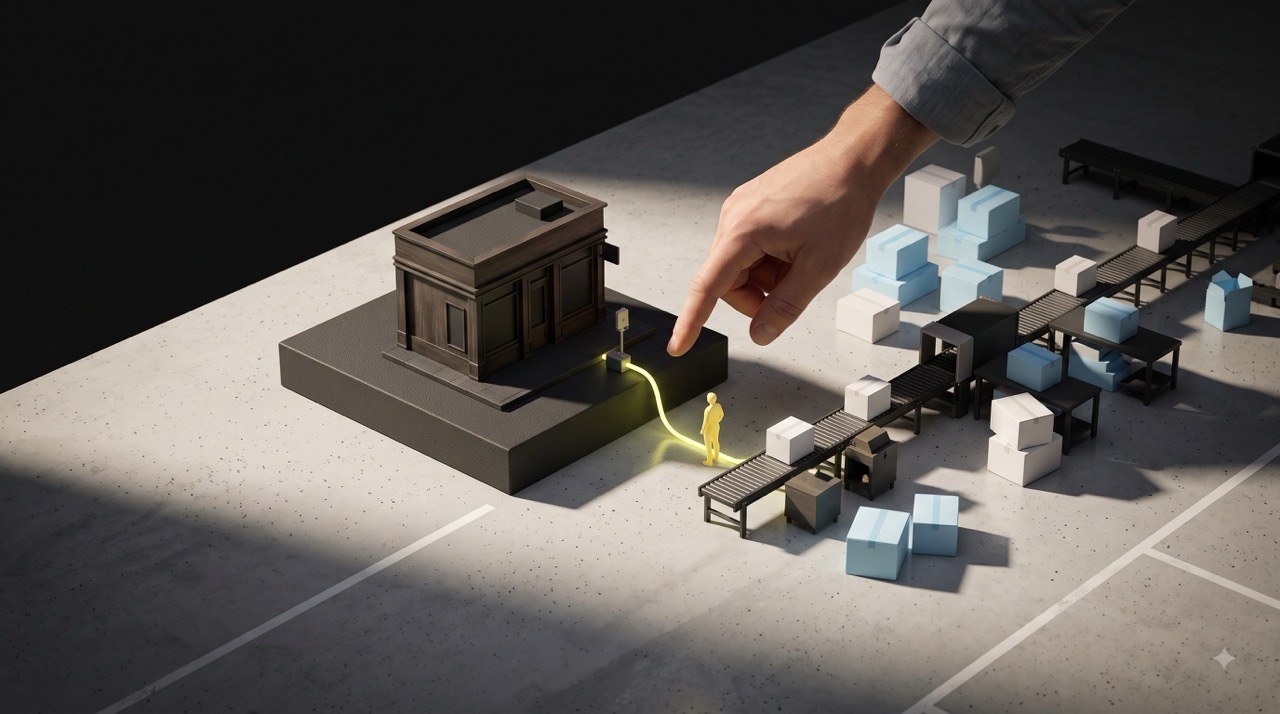
Most businesses adding e-commerce should start on a hosted platform such as Shopify, not a custom build. A custom platform earns its cost when a specific constraint makes the hosted route impossible: a catalogue or pricing model the platform cannot express, an integration it will not support, a marketplace with two sides to serve, or operational volume that turns manual steps into a daily cost. Until one of those is true, the storefront is not your bottleneck, and building one from scratch buys you maintenance rather than growth.
The market you are integrating into
The case for selling online no longer needs arguing. According to the Australia Post eCommerce Report 2026, Australians spent a record $82.6 billion online in 2025, up 14 percent year on year, across 9.8 million households. Of that, $18.9 billion went to pure online marketplaces, which is 23 percent of total online spend.
The useful signal in those numbers is not the growth. It is where the growth went. A significant and rising share of online spend is being captured by marketplaces rather than by individual retailer storefronts, which means the question worth asking is not "do we need a website that sells" but "where does our customer actually buy, and what do we own at the end of it".
What changed since this article was first published
The 2013 version of this article offered to build a single-product e-commerce page for a token sum. That offer is retired, and it is worth saying why rather than quietly deleting it.
In 2013, a small custom build was a reasonable answer, because hosted platforms were immature and a simple checkout genuinely had to be assembled. That is no longer true. Shopify and its equivalents now do the small-store job better and far more cheaply than any custom build, and they keep doing it - payments, tax, fraud, shipping rates and platform security are maintained by someone else. Recommending a bespoke storefront at that scale today would be selling a worse product at a higher lifetime cost. PixelForce takes on 5 to 10 clients per year and works on platform builds and integrations, so if a hosted store is the right answer for you, that is the answer you will get from us.
When custom is genuinely the answer
Four constraints reliably justify a build:
- The commercial model does not fit the platform. Subscription logic, complex configurable products, contract or tiered pricing per customer, or a catalogue whose structure the platform cannot represent without fighting it.
- The business is two-sided. A marketplace has supply as well as demand: onboarding, verification, availability, payouts and dispute handling. That is an operations platform with a storefront attached, not a store.
- The integrations are the product. When the value sits in what happens after the order - inventory, fulfilment, finance, field operations - the checkout is the smallest part of the work.
- Manual process has become a running cost. Exports, re-keying and reconciliation that were fine at ten orders a day are a salary at a thousand.
Integration is usually the real project
The word most people underweight in "e-commerce integration" is the second one. For Crop Shop Boutique we connected ShipBob, Klaviyo and Shopify in a 2-week development cycle: 100 percent of pre-shipment customer notifications automated and the manual CSV export workflow eliminated. No new storefront was built. The store was already fine. The cost was sitting in the space between three systems that did not talk to each other.
That project is the shape of a large share of profitable e-commerce work: keep the platform, remove the manual step, and let the team spend its hours on the parts a customer can see.
What the outcomes look like
After we rebuilt littlegren's online store, sales increased 300 percent year on year. Schnuzzle saw a 200 percent return on investment within the launch period and expanded from Australia to the USA. Where a build is warranted, this is the kind of return that justifies it - and where it is not warranted, no amount of engineering produces those numbers, which is exactly why the platform decision comes before the build decision.
What drives the cost
Any custom e-commerce engagement starts with Phase 1 Scoping & Design, which produces a costed plan rather than a ballpark. Development is then quoted against that plan, and what moves the number is the integrations, the catalogue and how much of the operation sits behind the storefront - a store that lists products is a fraction of the work of one that also runs inventory, fulfilment and finance. If a custom build turns out to be larger than the problem, that is useful information, and it is better to have it in the first conversation than three months into a build.
Where to go next
Our e-commerce solutions page covers the three ways to build and the work we have shipped. If you are weighing up the blueprint phase itself, see our web design process.