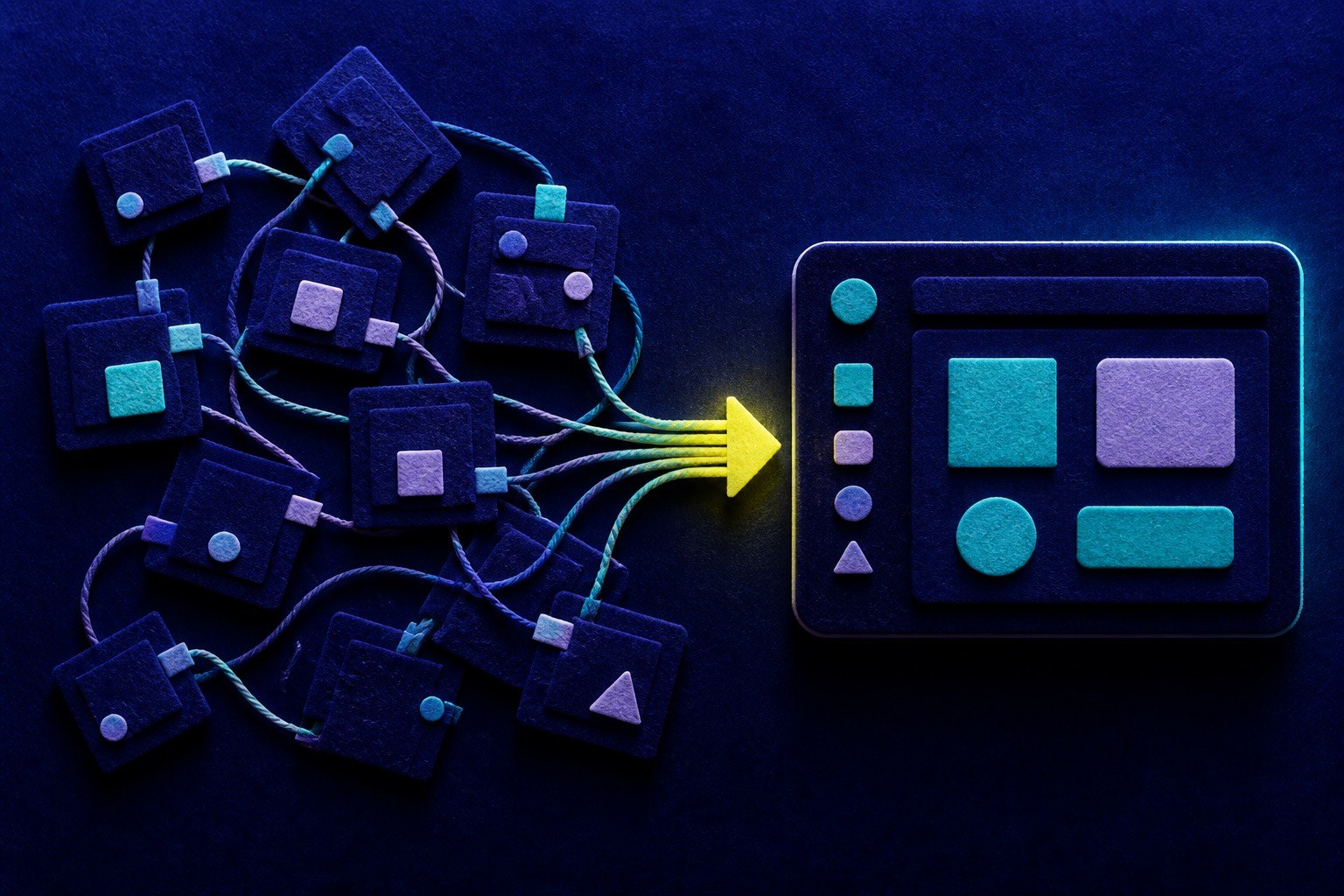
A custom web application is software that runs in the browser and is built around how your business actually works, rather than forcing the business to fit whatever the software assumed. It gives you the functionality of an installed application with no installation, no app store approval, and no separate build for each operating system.
What separates a web app from a website
A website presents information. A web application does work - it holds state, enforces rules, and changes something when you use it. If the thing you are on has complex interactivity, accounts, or a workflow that several people move through, it is a web application. Asana, Figma and Monday.com are the familiar examples, and they run in a browser tab on any device with a capable one.
That reach is the practical advantage. A phone, a laptop, a warehouse terminal or a smart television can all open the same application, and you are not subject to app store policies or review timelines when you need to ship a fix.
Where custom beats off-the-shelf
Off-the-shelf software is almost always the right answer when your process is ordinary. Accounting, payroll and email are solved problems and you should not be paying to solve them again.
Custom becomes the better economics when the process is the business. The signals are consistent: staff maintaining spreadsheets alongside the official system, data re-keyed between two tools that will not talk to each other, a workflow that exists only in one person's head, or a licence bill that scales with headcount for features nobody uses.
A concrete case. When EzLicence's financial reports would not balance, we replaced report-time reconstruction across a dozen unrelated tables with a canonical double-entry credit ledger covering 18 event types, with real-time capture and idempotent reprocessing. Every liability report now draws from one reconcilable source, finance discrepancy complaints stopped, and outstanding credit is aged into time buckets and categorised by source for cash-flow decisions. No off-the-shelf product was going to do that, because the problem was specific to how that marketplace works.
Integration is often the whole point
Frequently the win is not a new system but a connection between systems you already pay for. For Crop Shop Boutique we connected ShipBob, Klaviyo and Shopify in a two-week development cycle: 100 percent of pre-shipment customer notifications automated and the manual CSV export workflow eliminated. That is a small, bounded project with an immediate operational payoff, and it is a far more common shape of work than a ground-up platform.
What you are actually buying
The trade is ownership against convenience. With custom software you control the codebase, the data and the roadmap, and the application changes when the business changes rather than when a vendor decides. In return you carry the cost of building it and the responsibility for maintaining it. That is a reasonable trade when the process is a genuine advantage, and a poor one when you are rebuilding something you could have subscribed to.