
Many founders we meet started on a white-label platform, and for good reason. It is a quick, low-commitment way to get live and find out whether people will pay. Once demand is proven, the question changes: compare the cost and limits of staying with the cost and control of owning.
The short answer: rent while you test an idea. Own once it pays to: when demand is proven, and the platform’s limits or fees cost you more than owning would.
A white-label app is a rental. You can decorate it, but you cannot own it. You pay for software you will never own, as a monthly fee or a share of your revenue, on terms someone else sets, and often the platform also holds the payment relationship with your customers. Most of the record of what your members do stays in the platform’s database, which limits what you can build on it, AI included. Fees may grow with your business, without giving you ownership of the software.
What white label does well
It is worth being honest about this, because it is why so many good businesses start there.
- Speed You can be live in weeks, not months.
- Low upfront cost A monthly fee or a share of revenue, instead of a build budget.
- Standard features that work Sign-in, payments, content and messaging, already used by every other customer on the platform.
- No technical team The platform looks after the hosting, the updates and the app stores.
If you are still testing whether people will pay, that is a very good deal. Once the business works, the question is whether the platform still meets your needs at a cost that makes sense.
You can decorate a rental. You cannot own it.
A white-label platform is like a rented home. You can choose the paint and the furniture. You cannot knock down a wall, you follow the landlord’s rules, and the rent goes up when the landlord decides. When you move out, you take your furniture, and only if the lease says you can.
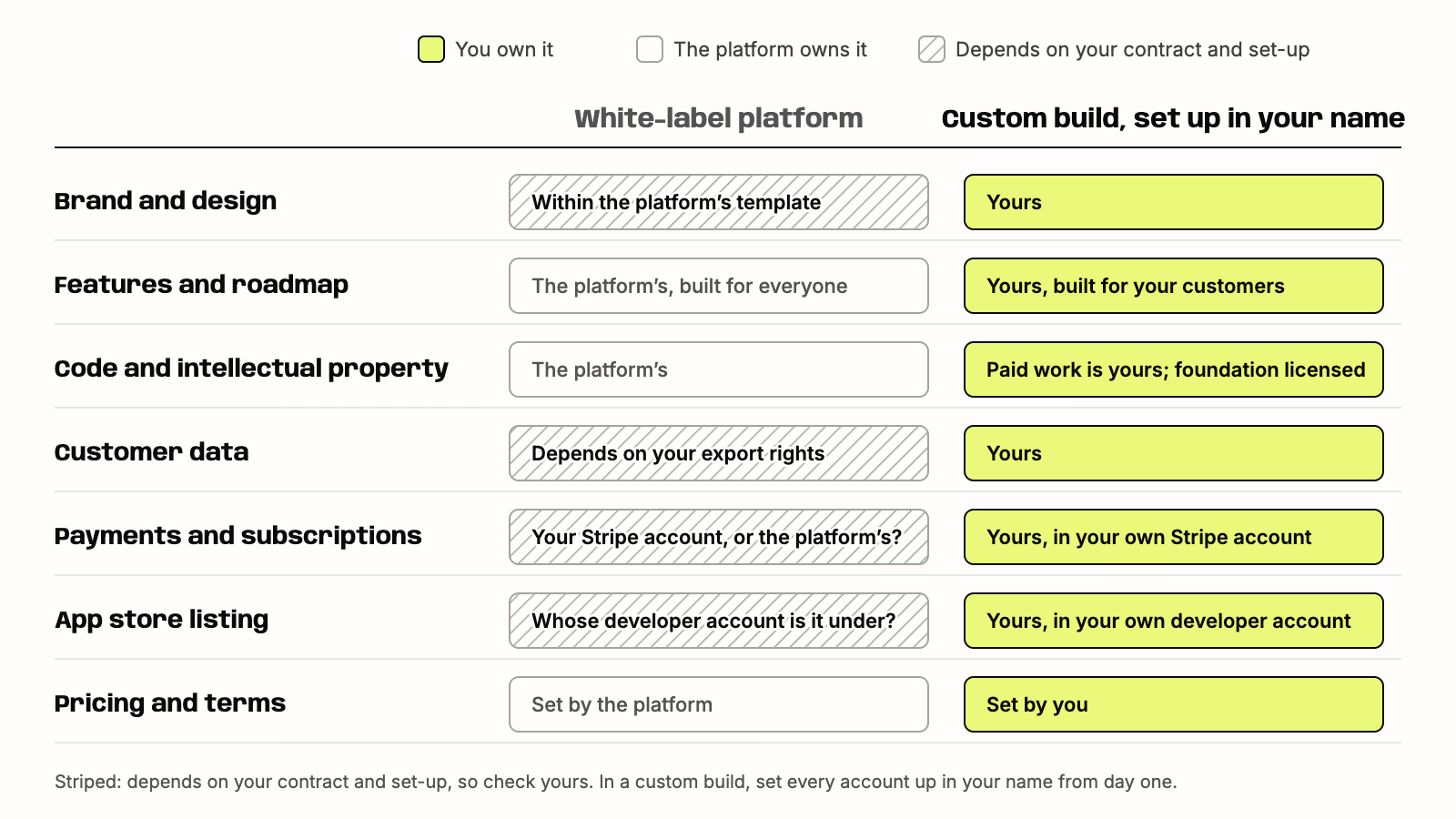
The same applies to course and creator platforms, where your members often use the platform’s own app rather than one with your name on it. Here is who owns each layer of your app on each path.
What you are really renting
- Code and features The platform owns them. You have access while you keep paying.
- Customer data Can you export every member, with their full history? Check before you need to.
- Payments Some platforms take your members’ payments on their own account, or on one they control. Others let you connect your own Stripe account, sometimes for an extra fee. If the platform holds the payment relationship, leaving needs their cooperation.
- App store listing If your app is published under the platform’s developer account, moving the listing depends on their cooperation. Even when the listing is in your own account, the app runs on the platform’s code, and on some platforms it stops working when you leave.
- Roadmap New features arrive when the platform builds them, and what you get can depend on your plan.
- Brand Within the platform’s limits: a template you can decorate, or just a channel inside its app.
- Pricing Fees often grow with your members or your revenue, on terms the platform can change.
- Exit value A buyer can value what you own. What you rent, they have to rent too.
Everyone has the same AI. Your data is the difference.
The AI models are open to every business now. What no competitor has is your members’ data: what each member watches, completes, skips and comes back for. That record is what makes AI useful to your business in particular.
On a white-label platform, that record sits in the platform’s database. You see it through the platform’s dashboards and exports, and some platforms show each member’s progress. Getting more out usually takes an API or an integration, often on a higher plan and with limits. The full, event-by-event history rarely comes out, and where a platform can stream activity to an analytics tool, it starts from the day you switch it on. Most platforms’ terms also let them use your members’ data, usually aggregated or de-identified, to improve their own products.
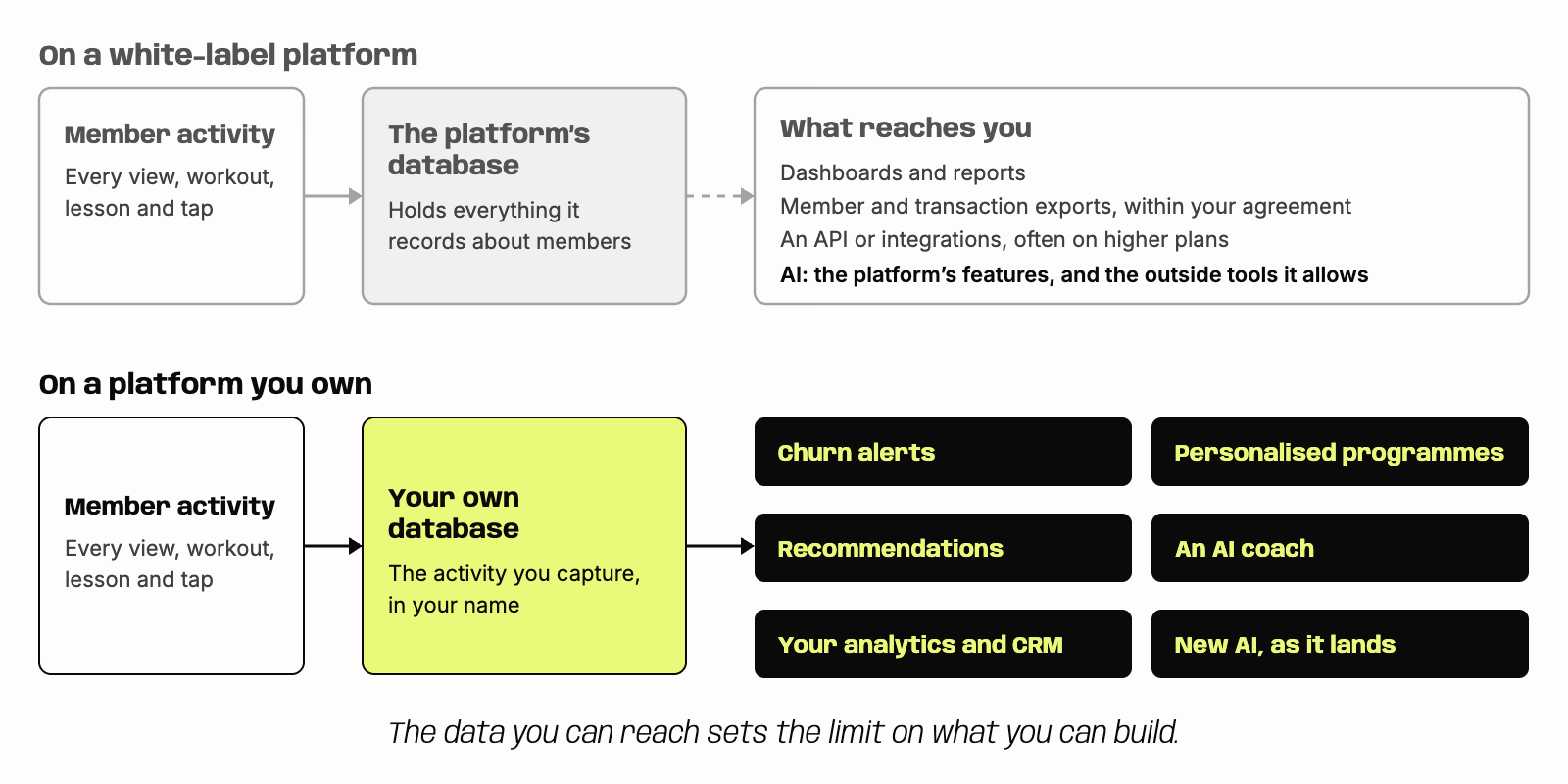
Platforms do offer AI: features and add-ons built for all their customers and, on some, a connection to an outside assistant. Useful, but what any AI can do for your members depends on the member data it can reach.
When the platform is yours, you decide what activity to capture, and it sits in a database set up in your name, ready to build on:
- Spot members about to cancel from a drop in their activity, before they leave.
- Personalise each programme to what that member actually completes.
- Recommend what comes next: the next class, video or product, from real behaviour.
- Offer an AI coach whose answers draw on each member’s own history.
- See the whole customer by joining app activity with your payments, CRM and marketing.
- Adopt new AI as it lands, on your timing rather than the platform’s.
EzLicence shipped an AI knowledge system in four weeks, with a 50% efficiency gain, on a platform PixelForce still operates. The data you can reach sets the limit on what you can build. Own the platform, and you decide what to capture.
The rent grows as you grow
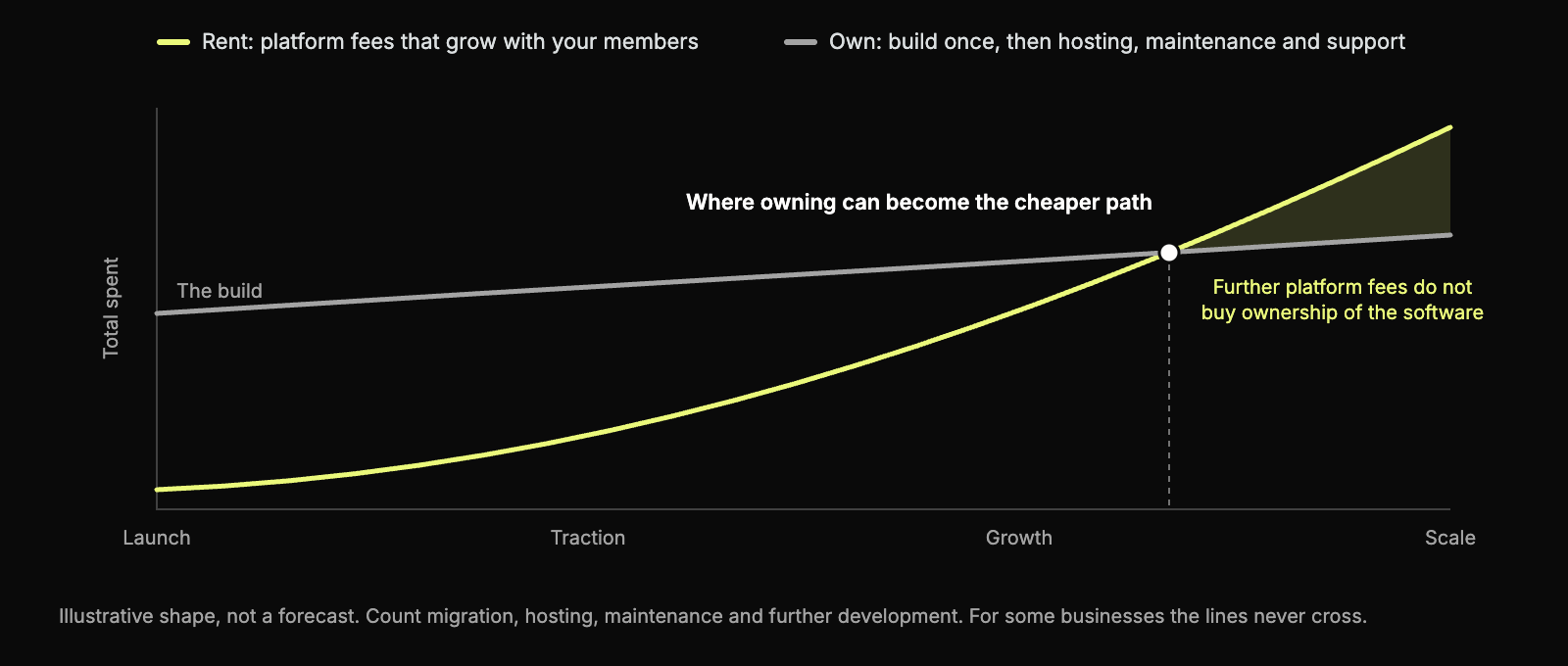
White-label pricing is often tied to your members, your revenue or both. That is fair while you are small. It also means that as you grow, your fees often rise with your members, your revenue or the plan limits you cross.
Owning works the other way round. It starts with a larger build cost, followed by migration, hosting, maintenance, support and further development. Compare both paths over the same period and at the same expected scale. The lines may cross, making owning cheaper over the period compared. For some businesses they never do, and staying is the better choice.
A buyer can value what you own
When a business raises capital or is sold, the buyer looks at what it owns: its code, its data, its customer relationships and the platform they run on. Revenue and customers on a rented platform still count. The product they run on does not belong to the business, so the buyer has to rent it too, on terms neither of them controls.
SWEAT is the clearest example from our own work. We built and scaled it from launch with Kayla Itsines and Tobi Pearce. It reached 30 million users across 155 countries, and when iFIT acquired it for $400M, the platform passed Big 4 due diligence at exit.
Rent is an expense. A platform you own is an asset.
Owning does not mean starting from scratch
The usual objection to a custom build is that it sounds slow and expensive. It does not have to be.
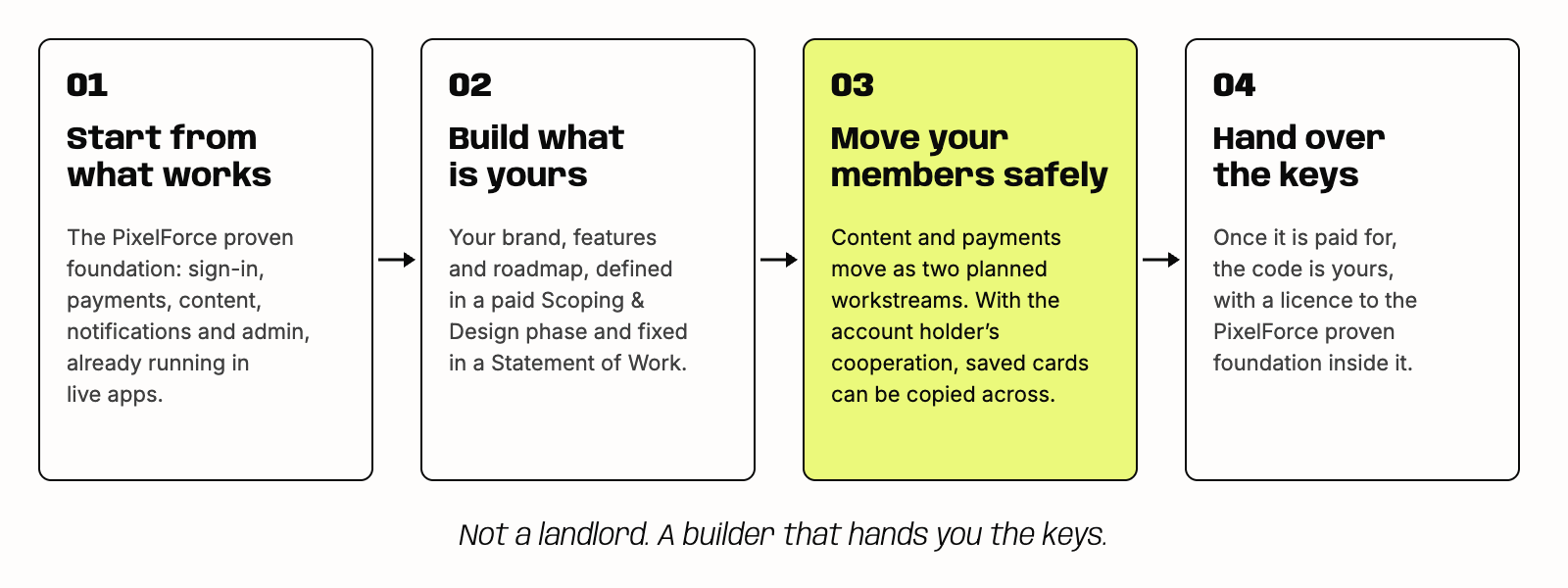
- Start from what works We never start from a blank page. The PixelForce proven foundation means sign-in, payments, content, notifications and admin are already running in live apps, so your budget goes on what makes your product different.
- Build what is yours Your brand, your features and your roadmap, agreed in a fixed-cost Statement of Work after a paid Scoping & Design phase, before any code is written.
- Move your members safely Content and payments move as two planned workstreams, explained below. Where the cards are held in Stripe and the account holder cooperates, members need not re-enter them.
- Hand over the keys Once it is paid for, the code is yours, with a licence to the PixelForce proven foundation inside it.
It is often faster than founders expect. Pilates Obsession’s full platform, with structured programmes, professional video and reliable infrastructure, was live within 12 weeks and on budget. NKO Club drew more than 10,000 members within 24 hours of launch, on auto-scaling infrastructure that held without degrading.
Moving off a platform without losing your members
The part most founders worry about is the move itself. It is two workstreams, planned together.
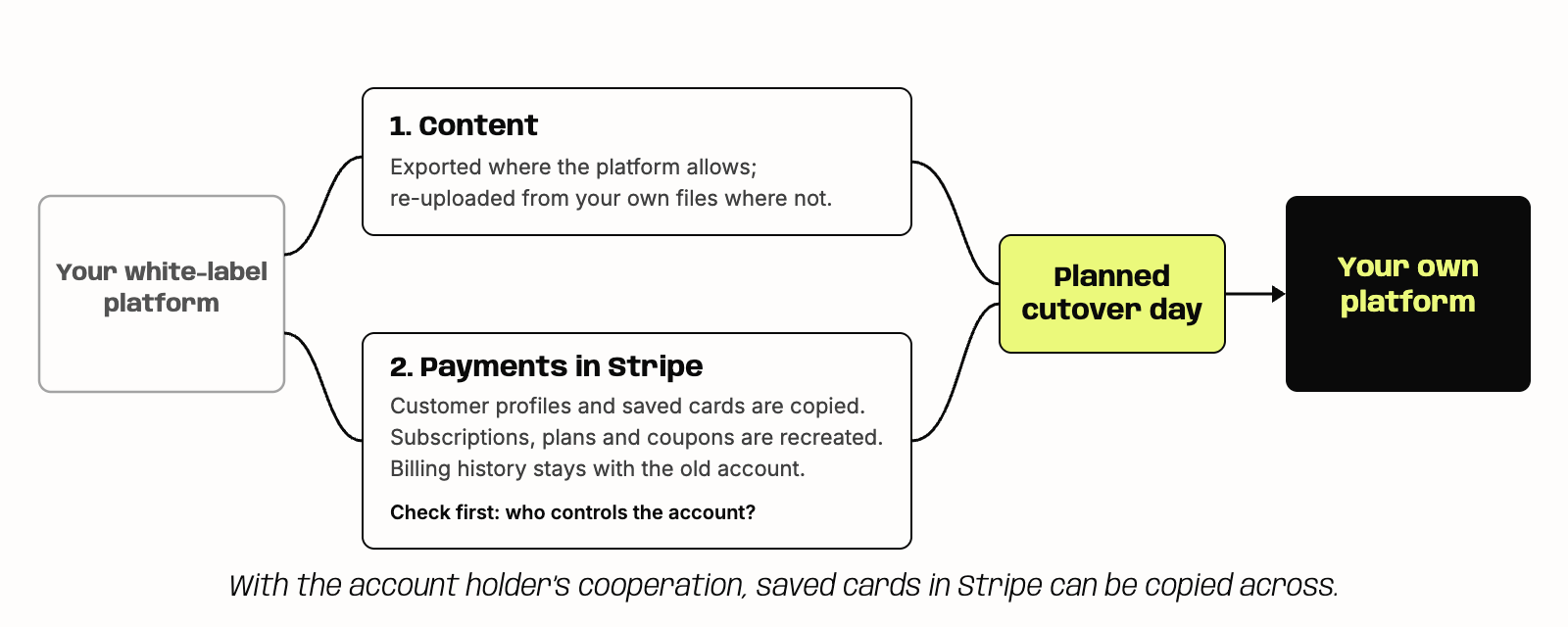
- Content Check which videos, programmes and records you can export or retrieve through an API. Some platforms offer no bulk export, so plan to re-upload anything else from your own files.
- Payments This is where the risk lives. Stripe can copy your customer profiles and their saved cards to your new account; whoever holds the old account starts the copy. It does not copy subscriptions, charges, invoices, billing history, plans or coupons. Subscriptions, plans and coupons are recreated on your new platform before the cutover; your billing history stays with the old account. Members who subscribed through Apple or Google in-app purchase sit outside Stripe, so they need their own plan.
- Member accounts Plan how members will sign in to your new app. Check which member details can be exported and which your agreement lets you transfer, and plan for members to register again where it does not.
Check your Stripe set-up today. Log in to Stripe, open Settings, then “Authorized applications”: any platform connected to your account is listed there. If you can only log in through a platform’s Express login, or you have no Stripe login at all, the platform controls the account. If you hold your own account with full access, the payment records are within reach, but check where the subscription logic lives: on some platforms it stays with the platform. If the platform controls the account, the move needs their cooperation and more planning. Either way, we agree the plan and any downtime before committing, and plan the customer communication well in advance.
Where the cards are held in Stripe and the account holder cooperates, members carry on without re-entering their card details. Some European and UK cards may ask members to confirm their payment again, and members who pay through Apple or Google need their own plan.
White label or custom build, side by side
| Factor | White-label platform | Custom build with PixelForce |
|---|---|---|
| Where it wins | Fast to launch, with a low upfront commitment to test demand | Owning what you build, for as long as you run it |
| Upfront cost | Low | Higher, and fixed before the build |
| Ongoing cost | Platform fees, often growing with your members | Hosting, maintenance, support and further development |
| The code | Owned by the platform | Paid work is yours; our foundation is licensed to you |
| Customer data and payments | Held on the platform’s terms | In your own accounts, as agreed in the Statement of Work |
| Data and AI | Dashboards and exports; AI within its limits | What you capture, in your own database, for your own AI |
| Brand and features | Within the platform’s limits; sometimes just a channel in its app | Designed around your brand and your customers |
| Roadmap | When the platform builds it, for everyone | When you decide, for your customers |
| At exit | A business that rents its core product | An asset a buyer can value |
Rent while you test. Own once it pays to.
When to stay, and when to own
Reasons to stay on white label
- you are still testing whether people will pay;
- the platform’s standard features cover what your members need;
- staying costs less than owning would over the same period;
- the platform’s terms support your growth and exit plans.
Signs it is time to compare owning
- you need features the platform will not build;
- platform fees are growing faster than the cost of owning would;
- you want your customer data and payments in your own accounts;
- you want to use your members’ data for your own analytics or AI;
- your brand is a big part of what members pay for;
- you are preparing to raise capital or sell.
Before you renew, ask your platform these five questions
- Can I export every member, with their full history Check what you can export, in what format, and what stays behind.
- Whose account holds my members’ payments If the platform controls it, moving later needs their cooperation.
- Whose developer account is my app published under If it is theirs, moving your app store listing depends on their cooperation.
- What happens to my app and members if I leave Know the answer before you need it.
- What will I pay at ten times my members or revenue Rent that grows with you is still rent.
Then ask us the same five about a custom build.
Ready to own it?
Book a free Discovery / Consultation Call. We sign an NDA, look at your current platform and your numbers, and give you three options and one recommendation, including staying where you are if that is the right call. Talk to PixelForce.