
Most people we meet have now tried an AI coding tool, and many arrive with a working prototype. So the question is fair: if everyone has the same tools, what are you paying an agency for?
The short answer: AI multiplies whoever is using it. In experienced hands it speeds up good decisions. In inexperienced hands it speeds up mistakes.
You do not need PixelForce to get access to AI. You need us for the decisions AI cannot make for you, and for the way we put AI to work: engineers decide first, AI drafts within the plan, and every release is checked before it ships.
“We have AI now. Why pay an agency?”
It is a reasonable question, and the honest answer starts by agreeing with it. AI has made some of the work of building software dramatically cheaper. It has not touched the parts that decide whether a product survives contact with real customers.
What AI made cheap
- Writing code
- First drafts of screens
- A clickable prototype
- Tests and documentation
What it did not make cheap
- Knowing what to build first
- Structure that survives growth
- Payments and renewals that always work
- Getting through app store review
- Owning it when it breaks
AI made typing cheap. Decisions cost what they always did.
Everyone has the tools. Not everyone is a builder.
The hardware store stocks every tool and material a builder uses. Nobody walks out of it a builder. AI is the same: a well-stocked toolbox, open to anyone. What you build with it depends on who is holding the tools, and on what you are building.
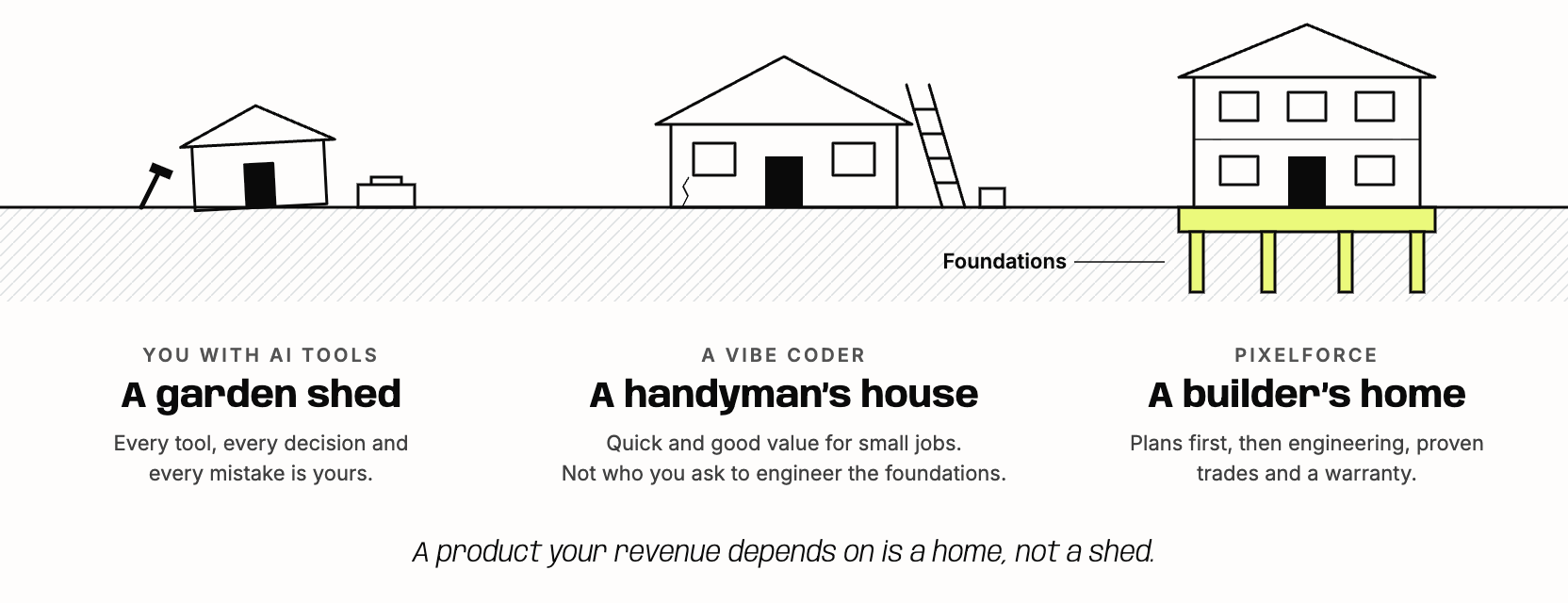
- Build it yourself with AI tools Every tool, every decision and every mistake is yours. That is fine for a garden shed: an internal tool, a prototype to test an idea, or a weekend project.
- Hire a vibe coder A handyman is quick and good value for small jobs. A handyman is not who you ask to engineer the foundations of a building you plan to live in.
- Engage a builder Plans first, then engineering, proven trades and a warranty. That is what PixelForce does for software.
A product your revenue depends on is a home, not a shed.
“I could just do this myself.” Then deploy it. On what server?
That is the honest reply to “I could just do this myself”. A demo can already be online. A live business still needs someone accountable for the hosting, access, backups, monitoring and recovery, and that is only the start.
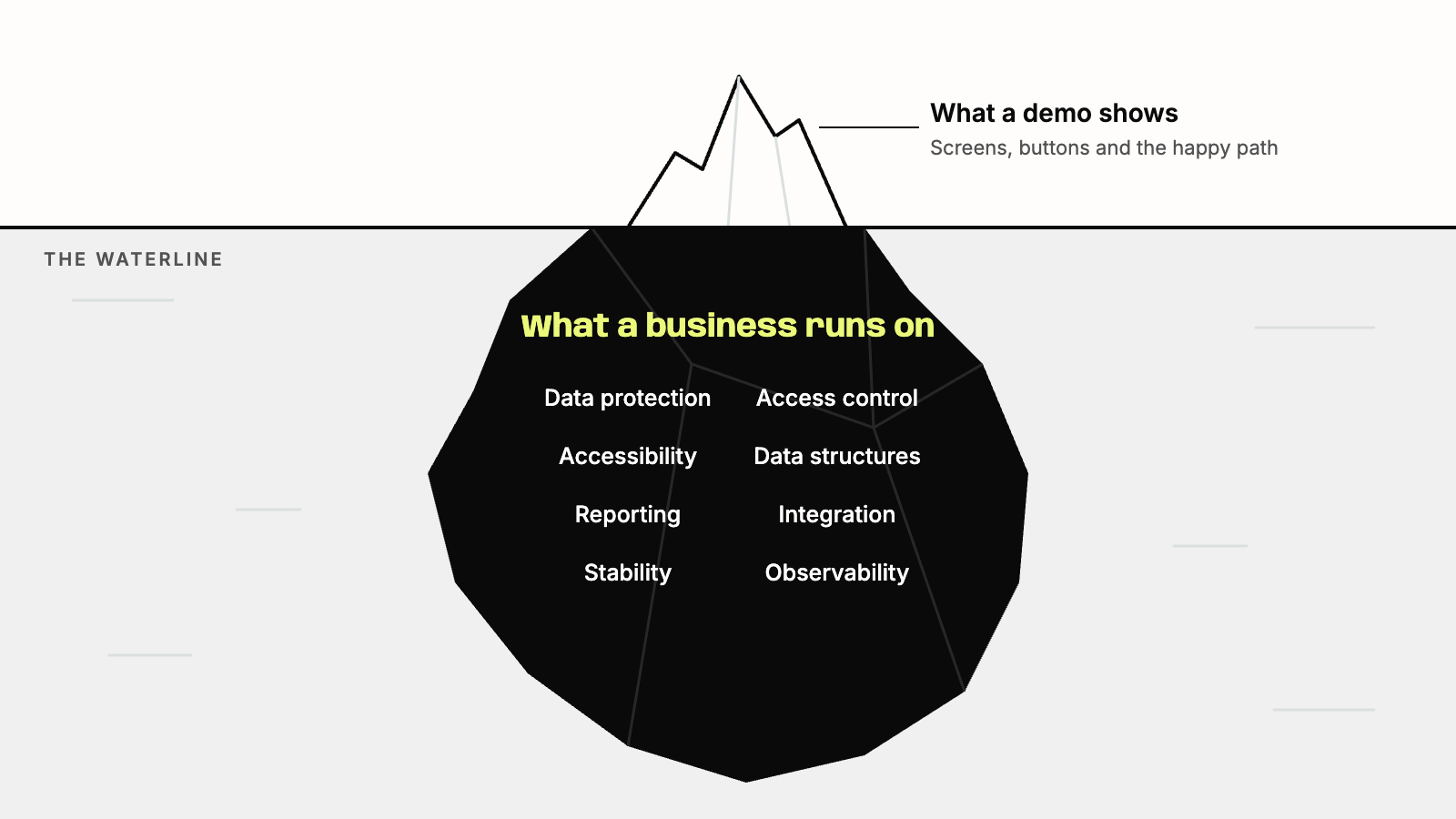
This is what a really good engineer answers before launch. None of it shows in a demo. All of it shows once real customers arrive.
- Data protection where does customer data live, and who can see it?
- Access control who can sign in, what can each person change, and who is kept out?
- Accessibility can someone using a screen reader or larger text still use it?
- Consistent data structures will this year’s data still make sense when you add features next year?
- Reporting can you see who signs up, who pays and who leaves?
- Integration does it talk to your payments, CRM and accounting?
- Stability what happens when 10,000 people sign in on day one?
- Observability when it breaks at 2am, who finds out first, you or your customers?
Every one of these is a decision someone has to make before launch. AI will happily write code for any of them. It will not tell you which ones you have forgotten.
What the research says: AI code needs an expert to check it
Three independent findings, none of them ours.
- 19% longer the extra time experienced developers using AI tools took to finish real tasks. Afterwards, they believed AI had made them 20% faster. Source: METR randomised controlled trial, July 2025 (16 developers, 246 tasks).
- 45% the share of AI-generated code samples with security flaws, across 80 coding tasks and more than 100 AI models. Source: Veracode, 2025 GenAI Code Security Report.
- 46% the share of developers who do not trust the accuracy of AI tool output, up from 31% a year earlier. Source: Stack Overflow, 2025 Developer Survey.
None of this means AI is bad. The METR authors describe their result as a snapshot of early-2025 tools, and the tools keep improving. The point is simpler: the people who use AI every day check everything it writes. If professionals check every line, someone qualified has to check yours.
Feeling faster is not the same as being faster.
How PixelForce uses AI: you do not pay a CEO to do the admin
Nobody pays a CEO a senior salary to do the admin. You pay them for the decisions that shape the company. Software now works the same way. AI does the admin of building an app. You pay us for the decisions, and for the system that keeps AI pointed at the right work.
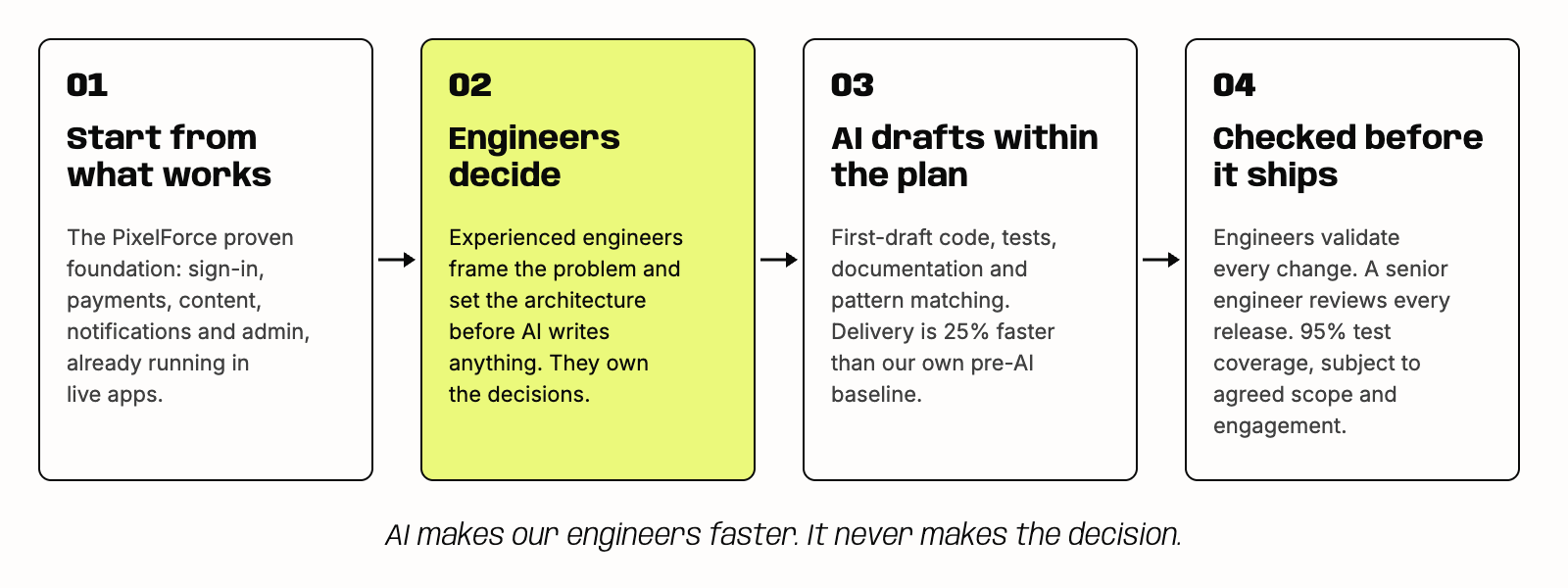
- Start from what works We never start from a blank page. The PixelForce proven foundation means sign-in, payments, content, notifications and admin are already running in live apps, so your budget goes on what makes your product different.
- Engineers decide Experienced engineers frame the problem and set the architecture before AI writes anything. AI never decides what gets built or how it is structured.
- AI drafts within the plan AI writes first-draft code, generates tests and documentation, and does the pattern matching. That is why delivery is 25% faster than our own pre-AI baseline.
- Checked before it ships Engineers validate every change, and a senior engineer reviews every release. Test coverage is 95%, subject to agreed scope and engagement.
AI did not lower what a good app costs. It raised what the same budget buys.
We build AI into client products too
EzLicence’s AI knowledge system, The Handbook, shipped in four weeks. It consolidated seven years of product evolution, delivers a 50% efficiency gain across workflows, and automates 90% of documentation updates with 10% human oversight.
Same AI, different results: experience is the multiplier
Your developers, a freelancer and our team can all buy the same AI tools. What cannot be bought is the record of what happened after each launch: what broke, what scaled, what customers did, and what it cost to fix.
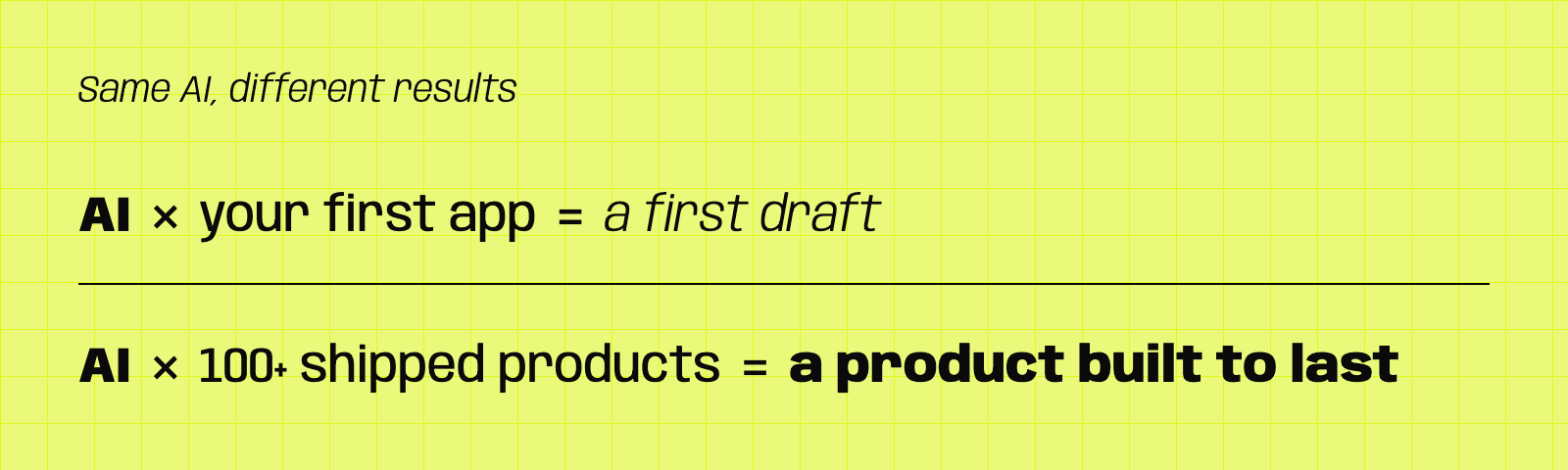
This is what sits behind every decision we make for you:
- Since 2013 founded in Adelaide, and building products ever since
- $40M+ client engineering budgets delivered
- 100+ products shipped
- $1.5B+ client revenue facilitated
- 15+ platforms rescued in the past three years
It is not a $20 subscription.
An experienced team using AI is not slightly better than a beginner using AI. It is a different, far safer thing.
Three ways to build your app, side by side
Each route has a place. Building it yourself gives you a fast, low-cost first demo, and a good freelancer is good value for a simple build. The difference shows after the demo: who makes the decisions, who checks the output, and who supports the live product.
| Factor | You with AI tools | A vibe coder | PixelForce |
|---|---|---|---|
| Where it wins | A fast, low-cost first demo | Good value for simple builds | Everything after the demo |
| How AI is used | You prompt it and judge the output | Depends on one person’s experience | Engineers decide, AI drafts, a senior engineer reviews every release |
| Who decides | You, learning as you go | One person’s judgement | Senior engineers, with a plan agreed before any code |
| Testing | Whatever testing you set up | Ask for the test plan | 95% test coverage, subject to agreed scope and engagement |
| When it breaks | You are the support team | One person’s availability | Our own in-house team, with monitoring and support |
| Insurance | You carry the risk | Ask to see it | Professional indemnity and public and products liability cover |
| Disaster recovery | Up to you | Ask how it works | Backups, point-in-time restore, failover and rollback |
| Governance | Up to you | Ask what is in writing | Fixed-cost Statement of Work, quality gates, UAT sign-off, weekly budget reports |
Some freelancers do carry insurance and keep backups. That is why the last three rows are questions to ask, not assumptions. Ask a vibe coder for the last three rows.
The commercial arrangement: judgement you can hold us to
Judgement is only worth paying for if someone stands behind it. This is what stands behind ours.
- AWS-accredited engineers 15+ AWS-accredited engineers. PixelForce is an AWS Advanced Tier Partner.
- Governance and control A fixed-cost Statement of Work agreed after a paid Scoping & Design phase, quality gates at every stage, formal UAT sign-off and weekly budget reports.
- Insurance in place Professional indemnity and public and products liability cover, with certificates of currency on request.
- Disaster recovery Automated backups, point-in-time restore, failover and rollback, on a 99.99% uptime track record.
- You own what we build Once it is paid for, it is yours, with a licence to the PixelForce proven foundation inside it.
- Done it 100+ times 100+ products since 2013, and 15+ platforms rescued in the past three years. We know what great looks like.
On security, we build the platform to your requirements and bring in an independent third party to verify it, because no team should audit its own work.
Five years, illustrated: the cheap build costs more
Here is how the costs tend to stack up for one subscription app that finds traction. It is an illustration, not a quote, and your numbers will differ.
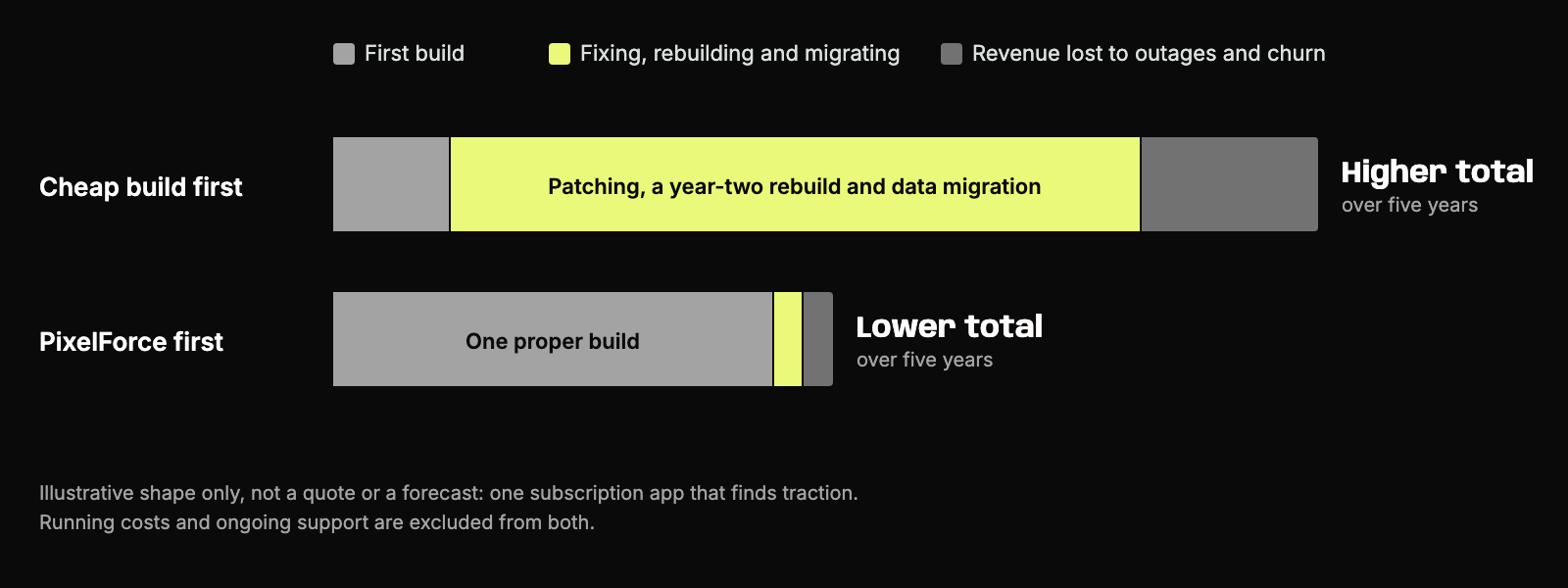
| Item | Cheap build first | PixelForce first |
|---|---|---|
| First build | Smaller | Larger |
| Patching as real customers arrive | Ongoing, and it grows | Minor |
| Rebuild on proper foundations (year two) | The full cost of a proper build | None |
| Data migration, mapping and backward compatibility | Required | None |
| Revenue lost to outages and churn | Significant | Minimal |
| Five-year total | Higher | Lower |
You pay for the proper build either way. The only choice is whether you pay for a cheap one first.
The rebuild costs what the proper build would have cost in the first place. Then comes the work of moving a live product across: mapping old data into the new structure, migrating members and subscriptions without losing anyone, and keeping older versions of the app working until every user has updated. That is a year spent rebuilding instead of growing. We will work through your own numbers with you.
If you already have developers: keep your team, add our hindsight
Your engineers can buy the same AI tools we use. They cannot buy the record of what happened after 100+ launches. We bring that, and work alongside them.
- Pattern recognition We have rescued 15+ platforms in the past three years, so we know which early decisions cost money later.
- Standards AI output is checked against engineering standards built from more than 100 projects.
- Proven foundations The PixelForce proven foundation, already running in live apps, so your team builds what is unique.
- Senior review A senior engineer reviews every release, whoever wrote the code.
Built to survive success
The real test of the decisions behind a product is what happens when it works.
- SWEAT $400M acquisition by iFIT. 30 million users across 155 countries. The architecture passed Big 4 due diligence at exit.
- EzLicence $100M+ annual bookings processed, on the platform we built and still operate.
- NKO Club 10,000+ members within 24 hours of launch, on auto-scaling infrastructure that held without degrading.
- Move With Us crashes down 50%, performance up 40% and zero business interruption for 200,000+ users.
Across our work: 98% first-time app store approval, AWS Advanced Tier Partner, 100% in-house and never subcontracted, and 30+ global awards.
Before you decide, ask whoever builds it these six questions
Whether it is you with AI tools, a freelancer, your own developers or us, the answers decide what the app really costs, long after the demo.
- Who owns the code, the accounts and the data If the answer is the developer, you are renting your own product.
- Where will it run, and who pays for the server Hosting, backups and updates cost money every month, and someone has to own them.
- How is it tested before your customers see it “We clicked through it” is not a test plan.
- What happens when it breaks at 2am, or the builder moves on One person who holds everything in their head is a single point of failure.
- Who carries the risk if it goes wrong A contract, insurance and a fixed scope protect you. Goodwill does not.
- What will it cost to run and change in year two The cheapest build is often the most expensive one to keep.
Ask us the same six. You get our answers in writing before any build starts.
Bring us your prototype
It is the clearest brief we will ever get. If it is already live and starting to break, read how we tell a fix from a rebuild first. Book a free Discovery / Consultation Call: we sign an NDA, review what you have built, and give you three options and one recommendation. Talk to PixelForce.