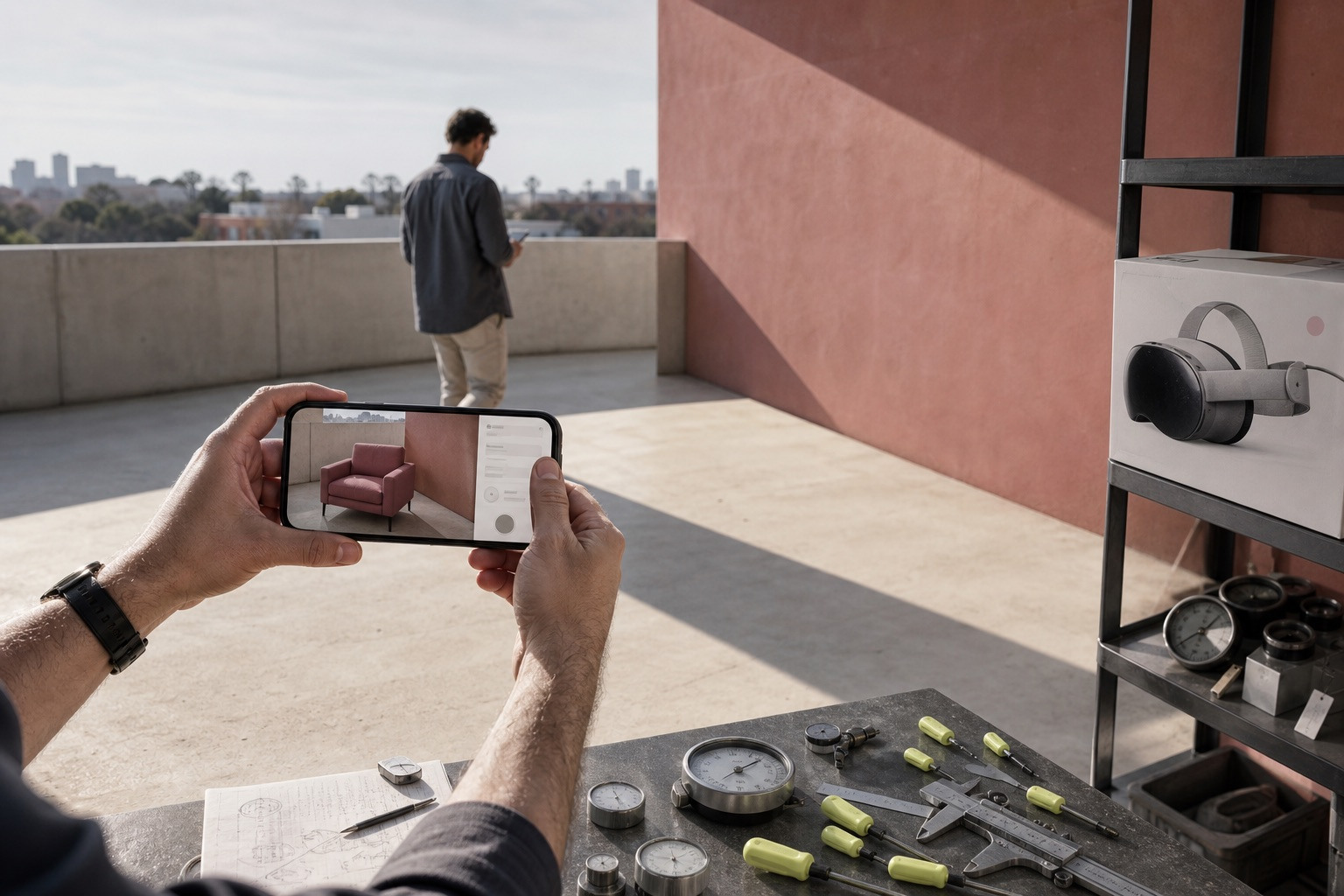
Augmented reality is worth adding to a business app in 2026 when it does one of four measurable jobs: lifts conversion on a physical product, cuts returns, shortens training, or removes a site visit. Outside those four, AR is a demonstration rather than a feature, and it adds cost to a product without adding a reason to use it. That is a narrower answer than the one this article gave in June 2017, the month Apple announced ARKit, when we predicted six industries were about to change. This is the scorecard, nine years on, and the decision test we now apply before any AR work is scoped.
What this article predicted in 2017
The original post was written the week ARKit shipped as a developer beta. It named six places AR would land: real estate and event walkthroughs, retail and creative placement of products in a customer's home, museum and education exhibits, live historical re-enactments, virtual-pet style entertainment, and automotive overlays that showed the inner workings of a car. Every one of those was technically feasible by 2018. The question this uplift answers is which ones anyone paid for.
The framework story - what ARKit and Core ML became as platforms - is covered in ARKit and Core ML, nine years on, and the media and publishing side in how augmented reality is transforming media. This article stays on the commercial question: where did the money go.
The scorecard: six predictions, one clear win
| 2017 prediction | What happened by 2026 | Verdict |
|---|---|---|
| Retail: place the product in the customer's home before buying | The only prediction with hard numbers. Shopify reports that products with 3D or AR content convert on average 94 percent higher than those without. A 2025 Snap and Publicis study of 4,028 shoppers found 80 percent felt more confident in a purchase made with AR and 66 percent said they were less likely to return it. | Paid |
| Real estate and events: walk through the building on your phone | Became 3D virtual tours viewed in a browser, not phone-held AR. The buyer wants to inspect remotely, and a tour delivers that without pointing a camera at anything. | Changed shape |
| Education: scan a beacon, see the exhibit in miniature | Real and widely built, but funded by institutions and grants rather than by users. It is a procurement market, not a consumer one. | Real, not commercial |
| Live experiences: re-enact history on a flat surface | Novelty installations exist; no repeatable business formed around them. | Did not pay |
| Entertainment: a virtual pet you care for through the camera | A handful of games, none of which built a category. The mechanics that did retain users lived inside existing games. | Did not pay |
| Automotive: overlay the inner mechanics of a car | Became two products: service and maintenance overlays for technicians, and sales configurators that show a car in your driveway. Both exist; both are owned by manufacturers, not app businesses. | Changed shape |
The pattern is not that AR failed. It is that AR paid where it attached to a transaction that already existed and lowered the buyer's uncertainty about it. Where AR had to create the reason to open the app, it did not.
The headsets did not change the answer
The 2017 article assumed the phone was a stepping stone to glasses. In 2026 the phone is still the device that matters commercially, and the headsets have made that clearer rather than less clear.
- Apple Vision Pro was refreshed with an M5 chip in October 2025 and, according to MacRumors, Apple raised its price to USD 3,699 in June 2026, cut its marketing budget by roughly 95 percent per Sensor Tower, and paused development of a next-generation headset in favour of smart glasses that will ship first without a display. Those are third-party prices and reports, not ours.
- visionOS 27 shipped on 14 September 2026 and still carries ARKit and RealityKit, so the frameworks are alive. The installed base is not one a consumer business can build a plan on.
- Android XR arrived with the Samsung Galaxy XR headset on 21 October 2025 at USD 1,799.99 (Samsung's price), and 9to5Google reports the first Google and Samsung Android XR glasses are due in the northern autumn of 2026.
Set against that, ARKit and ARCore run on the phones already in your customers' pockets. A retail AR feature reaches every one of them on day one. A headset feature reaches a rounding error. For a business app, that decides the platform before any other consideration does.
The four jobs AR does well enough to pay for
When a client raises AR in discovery, we test it against the four outcomes that have actually produced returns for other businesses. If the feature cannot be tied to one of them with a number you could measure after launch, we recommend against it.
- Raise conversion on a physical product Furniture, fixtures, eyewear, cosmetics, anything where the buyer's doubt is "will it suit my space or my face". This is the retail result above, and it is the strongest case by a distance.
- Cut returns The average e-commerce return rate sits around 19 to 21 percent against roughly 8.7 percent in physical stores, according to 2026 industry benchmarks. Anything that closes part of that gap pays for itself in reverse logistics before it earns a cent of new revenue.
- Shorten training Overlaying the correct step on the actual equipment reduces time to competence and error rates. This is where the automotive and industrial predictions ended up, and it is a business-to-business sale.
- Remove a site visit Remote assistance where an expert annotates what a field worker sees. The return is travel not taken, which is easy to count.
AR is a feature, so it is scoped like one
The mistake we saw most often in the years after 2017 was treating AR as the product. An app whose only job is to show something in AR gets opened once. The features that lasted sit inside a product that already has a job - a store, a service platform, a training system - and AR is one screen in it.
That framing changes how the work is costed. What moves the effort is not the AR itself, which the platforms now handle well, but the assets and the integration around it: whether accurate 3D models of the products exist or have to be produced, how many products need them, whether the feature must work on Android as well as iOS, how it connects to the catalogue and the cart, and how you will measure the lift. Those are the same cost drivers as any other feature in a native app, and they come out of scoping, not out of a rate card.
The same test applies before the AR question is even asked. If you have not yet established that people want the underlying product, AR will not rescue it - see how to validate an app idea before you build.
How to decide, in one meeting
- Name the transaction AR attaches to A purchase, a service call, a training module. If there is none, stop.
- Pick one of the four outcomes and the number that proves it Conversion rate on AR-enabled products, return rate, time to competence, visits avoided.
- Check the assets 3D models are the hidden cost; a catalogue of 40 products without models is a content project before it is a software project.
- Build for the phone ARKit and ARCore, inside the app your customers already have. Treat headsets as a later port if the numbers justify it.
- Ship it as one feature in a scoped release Measured against the number from step two, with a decision point to expand or remove it.
Across 100+ shipped products we hold a 98 percent first-time app store approval rate, and the AR features that made it into those releases were the ones that passed this test. The ones that did not were talked out of the scope in discovery, which is a legitimate outcome and usually the cheaper one.
If you are weighing AR for a retail, service or training product, the retail and e-commerce work is where most of the evidence lives, and our custom app development engagements start with the scoping that answers the question. Book a discovery call and bring the product you would want to show in someone's living room.