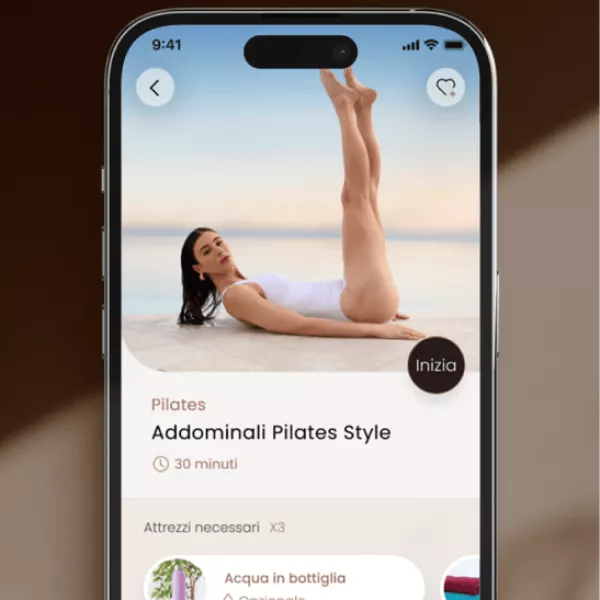
CSB is an Australian activewear brand founded by Rachel Dillon and run from Burleigh Heads on the Gold Coast, with an audience of more than a million on Instagram and collections that regularly sell out. Orders for United States customers were fulfilled through ShipBob, while the store ran on Shopify and customer email ran on Klaviyo. The three systems did not talk to each other. Staff bridged them by hand, exporting fulfilment data to CSV and importing it elsewhere to trigger the messages customers were waiting on. That is slow and expensive, but the real cost was the silence: a customer who had already paid heard nothing until the parcel turned up.

ShipBob, Klaviyo and Shopify connected in a two-week development cycle, and a spreadsheet removed from the middle of the customer experience.
The gap between paid and delivered
CSB is an Australian activewear brand shipping to customers around the world. Its United States orders were fulfilled through a third-party logistics partner whose tracking data never reached the systems the customer actually sees. For CSB we connected ShipBob, Klaviyo and Shopify in a 2-week development cycle: 100 percent of pre-shipment customer notifications automated and the manual CSV export workflow eliminated.
Pre-shipment notifications automated 100%
Development cycle 2 weeks
Platforms connected 3
The Problem
The Solution
PixelForce built a lightweight automation service that sits between the three platforms and removes the person in the middle. It watches ShipBob for shipments bound for United States customers, and at the point of pre-shipment it constructs an event and pushes it to Klaviyo via its API, which triggers the notification workflow. When a shipment is dispatched, it extracts the tracking number, builds the carrier tracking URL and writes a fulfilment record back into Shopify against the correct order and line items. It runs on cloud infrastructure with retries and alerting, so a temporary failure is retried rather than silently dropped.
The Outcome
For CSB we connected ShipBob, Klaviyo and Shopify in a 2-week development cycle: 100 percent of pre-shipment customer notifications automated and the manual CSV export workflow eliminated. Tracking now appears in the customer's order history in Shopify as well as in their inbox, without anyone touching a spreadsheet.
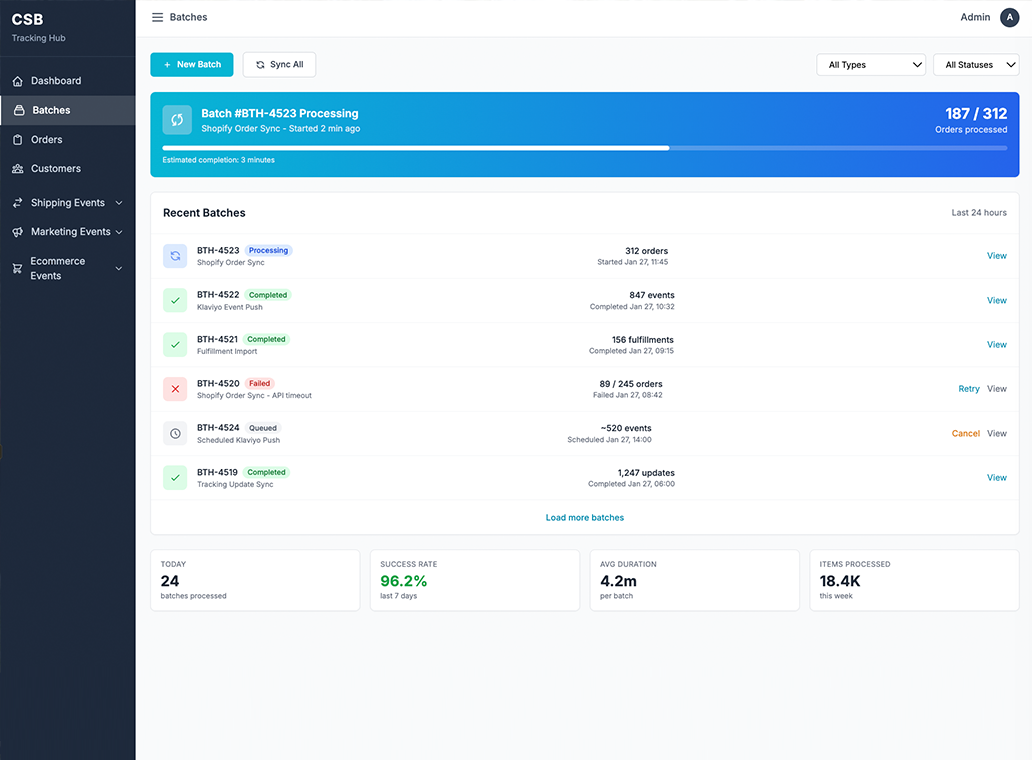
Three systems and a person in the middle
CSB, formerly trading as Crop Shop Boutique, is an Australian activewear brand founded by Rachel Dillon and based at Burleigh Heads on the Gold Coast. It describes itself as an everyday athleisure brand designed in Australia for inside and outside the gym, and it has built a following of more than a million on Instagram, with new collections that sell out quickly. Growth of that kind arrives as an operations problem before it arrives as anything else, and CSB had reached the point where international fulfilment was working commercially but not informationally.
The gap was in orders bound for the United States, fulfilled through the third-party logistics provider ShipBob. Shopify held the order, Klaviyo held the customer relationship and ShipBob held the fulfilment reality, and no connection existed between them. Staff moved data across by exporting CSV files and importing them elsewhere so notifications could be sent. The process failed the way manual processes always fail: orders missed, information stale, messages late or duplicated. The customer experience of it was worse than the internal cost. Somebody who had bought from a brand they follow closely paid, and then heard nothing until a parcel arrived from the other side of the world.
Three platforms, no connection
Shopify held the order, Klaviyo held the customer communication and ShipBob held the fulfilment status. Each had its own API and its own way of identifying an order, and nothing joined them.
A person as the integration
Staff exported CSV files from one system and imported them into another to trigger notifications. It consumed time, and it failed quietly whenever somebody was busy or an export was missed.
Silence at the worst moment
United States customers received nothing between paying and the parcel arriving. For a brand whose customers follow it daily, that silence did more damage than a slow delivery would have.
Weeks, not months
The problem was live and costing goodwill every day. The solution had to be scoped to the actual gap rather than expanded into a general integration platform.



CSB operates from the Gold Coast and PixelForce works from Adelaide and Sydney. A two-week cycle only works when the brief is settled before development starts and does not move during it, so the front of the engagement was spent agreeing exactly which orders were in scope, what triggers a notification, and who owns the message content. Drawing that line is what let the team build quickly without the result being fragile.
Hinney Lo Founder & CEO, PixelForce
Book a consultationMost integration projects fail by getting bigger. Somebody says the word platform and a two-week job becomes a six-month one that solves problems nobody has yet. The value here was in scoping it down to the two things that were actually broken and building only those.
Swipe to explore
Building the smallest thing that solved it
The discipline in this engagement was refusal. A brief like this attracts scope: a general integration layer, a rules engine, a dashboard, an abstraction connecting any future platform to any other. None of that would have shipped in two weeks, and none of it was the problem. PixelForce scoped the work to the two data movements that were actually broken and built precisely those, which is why the timeline held. Scoping and design always precedes development at PixelForce, and on a short integration engagement scoping is mostly the work of deciding what not to build.
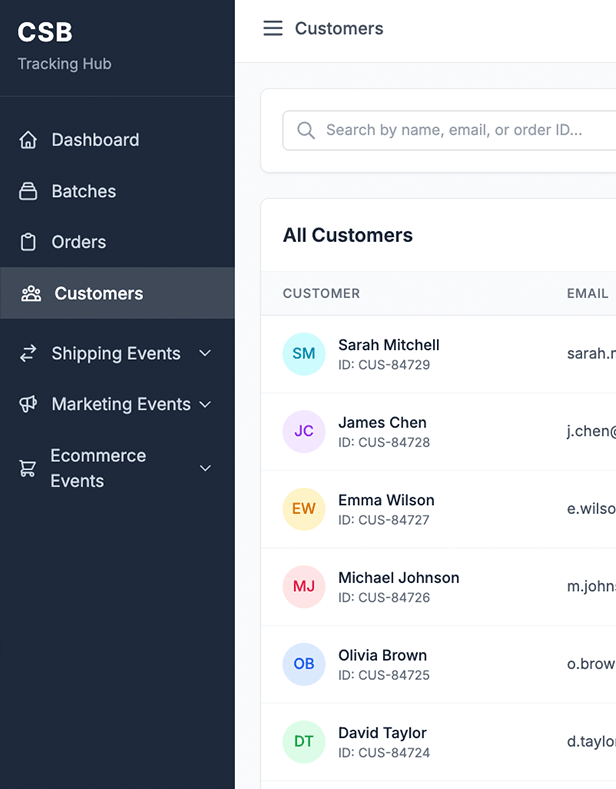
The first movement is the pre-shipment notification. The service monitors ShipBob for new shipments, filters for orders destined for United States customers, and when an order reaches the pre-shipment state it constructs a custom event carrying the order details and pushes it into Klaviyo through the REST API. Klaviyo's own workflows take it from there, which is deliberate - the message content and its timing belong to CSB's marketing team, not to a developer, so the integration supplies the trigger and the data and stops.
The second movement is harder, and it is where integration work usually goes wrong. When ShipBob marks a shipment as dispatched, the service extracts the tracking number, builds the carrier tracking URL, and then has to attach it to the right order in Shopify. Shopify models fulfilment at the level of line items, not orders, and the two systems identify products differently, so the mapping has to be resolved and validated before anything is written. Attach a tracking number to the wrong line item and the customer sees a confident, precise, incorrect answer, which is worse than no answer at all. Once validated, the service creates or updates the fulfilment record and the tracking appears in the customer's order history in the same place they bought from. It runs on cloud infrastructure with the unglamorous parts done properly: retry logic for transient API failures, logging, and alerting so anything unresolved is escalated to a person rather than dropped. Automation that fails silently is more dangerous than the manual process it replaced, so quality assurance concentrated on the failure paths rather than the happy one.
Packed · Dispatched · Tracked
No spreadsheet in the middle
The customer stopped waiting in silence, and nobody had to export a CSV again.
- Pre-shipment trigger
- Klaviyo custom events
- Tracking write-back to Shopify
- Line-item mapping
- Retries and alerting
- Scoped to two weeks
01 06
Pre-shipment trigger
The service monitors ShipBob for shipments bound for United States customers and fires when an order genuinely enters the pre-shipment state. That timing is deliberate: a notification sent too early describes something that has not happened, and a customer told twice that their order is on the way trusts the next message less.
02 06
Klaviyo custom events
Order details are pushed into Klaviyo as a custom event through its API, and Klaviyo's own workflows send the message. The split is intentional - the integration owns the trigger and the data, while the wording, design and timing of the email stay with CSB's marketing team, where they can change without a developer.
03 06
Tracking write-back to Shopify
When a shipment is dispatched, the service extracts the tracking number, builds the carrier tracking URL and writes a fulfilment record into Shopify against the original order. Tracking therefore appears in the customer's order history in the same place they bought from, rather than existing only inside an email they may have lost.
04 06
Line-item mapping
Shopify models fulfilment at line-item level and the fulfilment system identifies products its own way, so the mapping between them is resolved and validated before anything is written. This is the step that quietly breaks most integrations - attaching tracking to the wrong item gives the customer a precise answer that happens to be wrong.
05 06
Retries and alerting
Transient API failures are retried automatically rather than treated as lost work, and anything the system cannot resolve is logged and escalated to a person. Automation that fails silently is worse than the manual process it replaced, so the failure paths received more attention than the successful one.
06 06
Scoped to two weeks
The engagement deliberately did not build a general integration platform. It built the two data movements that were broken, on cloud infrastructure that scales with order volume. That refusal of scope is why a live customer-experience problem was fixed in a fortnight instead of a quarter.
Services on the CSB build
Frequently Asked Questions
CSB, formerly Crop Shop Boutique, is an Australian activewear and athleisure brand founded by Rachel Dillon and based at Burleigh Heads on the Gold Coast, selling internationally through Shopify with an audience of more than a million on Instagram. PixelForce built the automation connecting its fulfilment, email and e-commerce platforms. For CSB we connected ShipBob, Klaviyo and Shopify in a 2-week development cycle: 100 percent of pre-shipment customer notifications automated and the manual CSV export workflow eliminated.
PixelForce built a cloud-hosted automation service connecting three platforms. It monitors ShipBob for shipments bound for United States customers, pushes a custom event into Klaviyo at pre-shipment to trigger the customer notification, and on dispatch extracts the tracking number and writes a fulfilment record back into Shopify against the correct order and line items. It includes retry logic for transient API failures, logging and alerting so unresolved cases reach a person.
By building a service that watches the fulfilment system for state changes and translates them into the other two platforms. At pre-shipment it sends a custom event to the email platform, which owns the message itself, and on dispatch it resolves the tracking number and writes a fulfilment record into the e-commerce platform. The hard part is identity: the three systems name orders and products differently, so the mapping must be resolved and validated before anything is written, or tracking gets attached to the wrong item.
A tightly scoped integration between existing platforms is one of the faster pieces of work PixelForce does. The CSB integration across ShipBob, Klaviyo and Shopify was delivered in a 2-week development cycle. That speed comes from restricting the build to the data movements that are actually broken rather than constructing a general integration platform. Larger programmes still follow the full sequence of a free consultation, Phase 1 Scoping and Design, Phase 2 Development, QA and Release, and Phase 3 Post Launch Support.
A narrow integration between existing platforms is a much smaller piece of work than a product build, and it is scoped and quoted on its own. For full product engagements PixelForce prices in phases: Phase 1 Scoping and Design first, then Phase 2 Development, QA and Release quoted against the blueprint Phase 1 produces. Whatever the size, the cost is fixed in a Statement of Work before development starts.
Because the period between payment and delivery is when a customer is most anxious and a brand is most silent, and for international orders that period is longest. Manual notification processes fail exactly when volume is highest, which is when the most customers are affected. Automating them makes the communication reliable rather than dependent on somebody remembering to run an export.
An off-the-shelf connector is the right answer when the systems are common and the workflow is standard, and it should always be checked first. A custom integration earns its place when the logic is specific to the business, as it was for CSB, where only orders bound for one market were in scope and tracking had to be mapped to Shopify line items correctly. The decision is a scoping question, not a technology preference.
Up next
More products we have designed, built and launched end to end.