Brad Gerlach was world-ranked number two in 1991, then left the tour and reinvented himself as one of the best tow-in big-wave riders of the early and mid 2000s, winning the 2006 Billabong XXL Biggest Wave award for a 68-foot wave at Todos Santos. What he built afterwards was Wave Ki, a land-based method for training surfing movement out of the water. The problem with a method is distribution. Surf coaching has always been geographically bound, and a body of technique that exists only in one coach's head reaches the few hundred people who can stand in front of him.

How we turned Brad Gerlach's surf training method into a subscription platform that releases it in the order he teaches it.
Land training for better surfing
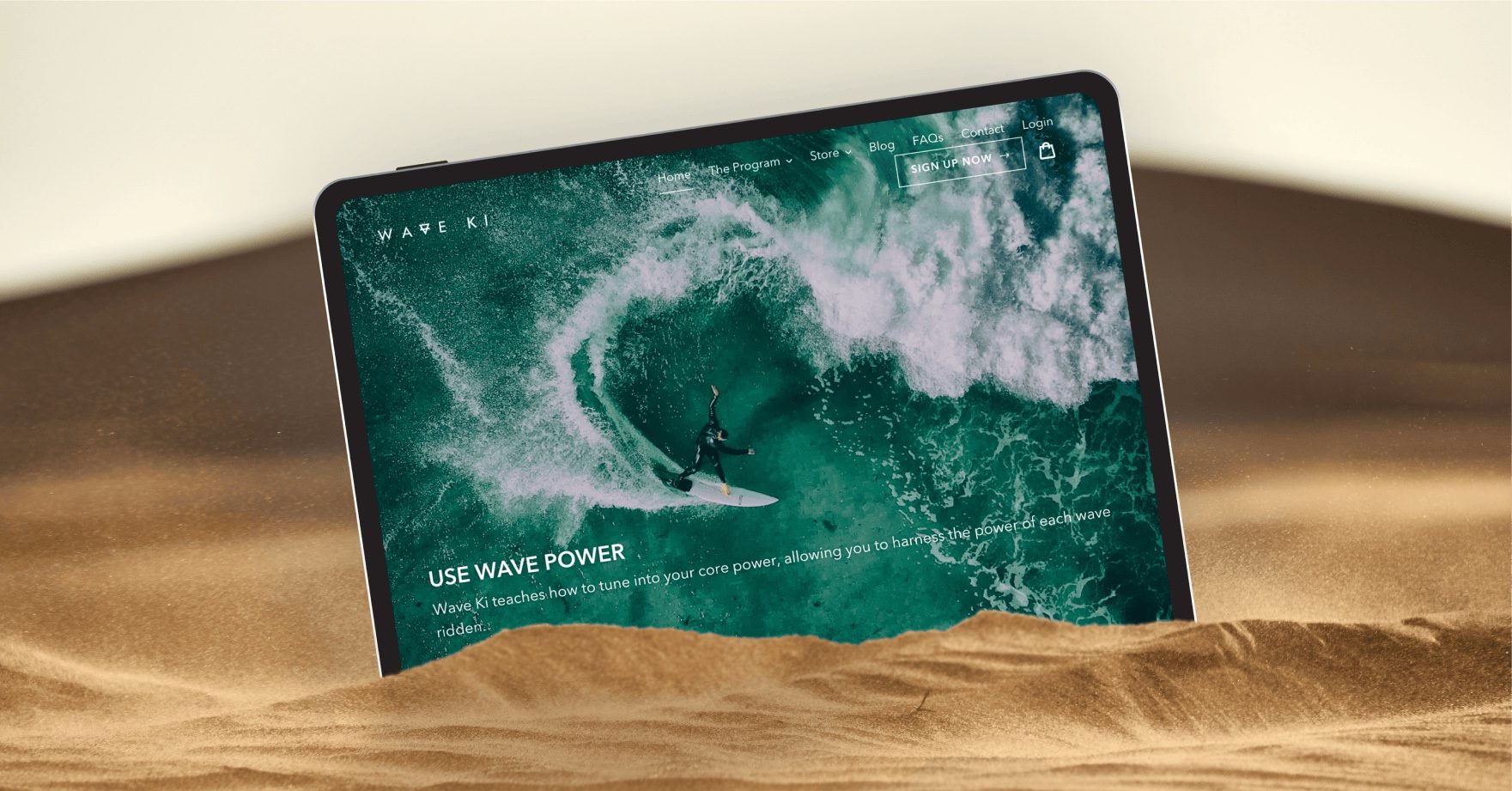
PixelForce built Wave Ki as a subscription web platform and member portal, not a mobile app. It delivers Brad Gerlach's land-based surf training method as a structured video curriculum that unlocks in sequence, alongside live streams and members-only Q&A, to subscribers anywhere in the world.
Subscription USD 34.95/mth
Tutorial and follow-along videos 283
Module unlock interval 21 days
The Problem
The Solution
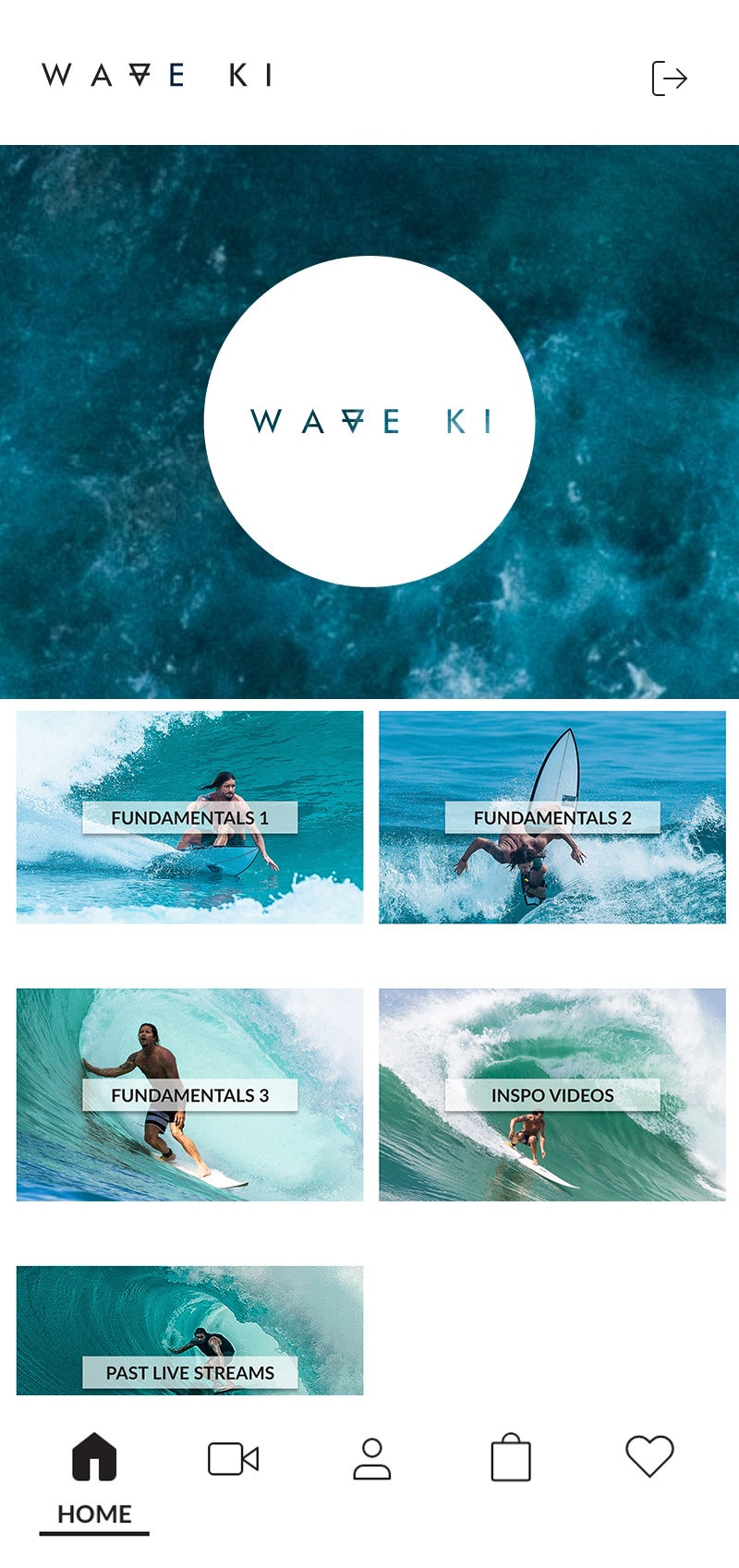
PixelForce built Wave Ki as a subscription web platform with a member portal, rather than as a mobile app. That was the right shape for the product: this is land training that people do in a garage, a lounge room or a car park with a laptop or phone browser propped up in front of them, and there is no capture, no sensor and no offline requirement that would justify a native app. The structure is the interesting part. Rather than publishing a searchable video library, the platform releases the method in the order Gerlach teaches it, with each module unlocking 21 days after the previous one is completed.
The Outcome
Wave Ki runs today as a live subscription platform, priced at USD 34.95 per month or USD 289 per year on its own pricing page, accessed 26 July 2026. That page lists 283 tutorial and follow-along training videos with 14 supporting PDFs, plus a Wave Ki Body library of 107 guided mobility and strength videos and 9 further PDFs. The method has drawn independent coverage in Stab Magazine, on Surfd and on the Surf Splendor podcast.
A method that only existed in one place
Wave Ki Surfing, Inc. is Brad Gerlach's business, built around a training method rather than a product catalogue. His competitive record is a matter of public record: world-ranked number two in 1991, then a second career as a tow-in big-wave surfer, including the 2006 Billabong XXL Biggest Wave award for a 68-foot wave ridden at Todos Santos. Wave Ki came out of a specific observation about how surfing is taught. Unlike tennis or gymnastics, surfing has almost no standardised progression - technique passes down informally, by watching whoever is good at your local break.
Gerlach's answer was to codify the movement, on land, into a sequence that can be practised without a wave. That makes it teachable at distance, and it is what made a digital platform worth building. PixelForce was engaged to turn a coach's sequence into software: something that holds the curriculum in order, gates it so that people work through it rather than skip ahead, handles the subscription, and streams a large volume of video reliably to members in different countries and on very different connections.
A curriculum, not a library
The value of the method is its order. A platform that let a subscriber jump straight to the advanced material would have delivered the videos and destroyed the teaching.
Video is the whole product
Several hundred tutorial and follow-along videos are what a member pays for. Playback quality and reliability across countries and connection speeds is not a technical detail here, it is the service.
Web, not an app
Members train in a garage or a lounge room with a browser in front of them. No capture, no sensor and no offline requirement, so a native app would have added cost and app store friction for no member benefit.
Subscription from day one
The business model is recurring and international. Billing, access and content entitlement had to be one coherent system rather than three that argue with each other.



Wave Ki operates out of the United States and PixelForce works from Adelaide and Sydney, on close to opposite clocks. The engagement was structured around that: requirements settled in concentrated workshops, then a written product definition detailed enough that neither side had to wait for the other to wake up. On a product whose logic comes from one person's coaching method, getting that method written down precisely was the most valuable thing scoping produced.
Hinney Lo Founder & CEO, PixelForce
Book a consultationThe client did not ask us for a video website. He asked us to teach his method at distance, and those are different products. Once you accept that the order is the value, the platform stops being a library with a paywall and starts being a curriculum that decides what you are ready for.
Swipe to explore
How we built it
The engagement began with Phase 1 Scoping and Design. Workshops produced a Business Requirements Document, the UX/UI design, a Product Requirements Document and a fixed-cost Statement of Work before any development began. Scoping and design always precedes development at PixelForce, and the decision that came out of it here shaped everything else: this is a web platform, not an app. Stating that in writing at the start, with the reasoning attached, is what stopped it being relitigated later.
The platform is built around entitlement rather than around a content index. A subscription grants access to the curriculum, and the curriculum releases itself in order, with each module unlocking 21 days after the previous one is completed. That gating rule is the software expression of the coaching method: a movement has to be lived in before the next is layered on top, and a platform that ignored that would have been a faster way to deliver a worse result. Around it sit the member portal, the live streams and members-only Q&A that give subscribers direct contact with Gerlach and his team, and the subscription billing that keeps access and entitlement in step.
Underneath, the work is video delivery at scale. Members are in different countries on connections ranging from fibre to a phone tethered at a beach car park, so playback runs through a content delivery network that serves each member from close by, with quality adapting to the connection rather than buffering against it. Progress is tracked per member, both because the unlock rule depends on it and because that data shows where in the sequence people slow down or stop - the most useful thing a coaching business can learn about its own method. Onboarding was designed as part of the curriculum rather than as a sign-up form, and every release moves through structured quality assurance.
Watch · Practise · Unlock
The method, released in order.
A coach's sequence, turned into software that refuses to let you skip ahead.
- Sequenced curriculum
- Member portal
- Video delivery
- Live streams and Q&A
- Subscription and access
- Built for the browser
01 06
Sequenced curriculum
The platform releases the method in the order it is taught. Each module unlocks 21 days after the previous one is completed, so a member works through the progression rather than browsing it. This is the feature that distinguishes Wave Ki from a video library, and it is a coaching decision expressed in software.
02 06
Member portal
One place that holds a member's subscription, their position in the curriculum and everything their access entitles them to. Because entitlement and progress live together, what a member can open always follows from where they have actually got to.
03 06
Video delivery
Several hundred tutorial and follow-along videos are the product, so playback is the service. Delivery runs through a content delivery network, so a member in Australia and a member in California are both served from nearby, with quality adapting to whatever connection they are on.
04 06
Live streams and Q&A
Recorded video teaches the movement; live streams and members-only Q&A handle the part recorded video cannot, which is the individual question. Wave Ki lists both, along with direct access to Brad and the Wave Ki team, as part of what a subscription includes.
05 06
Subscription and access
Billing and entitlement are one system rather than two. A monthly or annual subscription decides what a member can reach, and lapses and renewals move access with them. On a recurring-revenue product this is the part that has to be correct every day.
06 06
Built for the browser
Members train at home with a laptop or phone browser in front of them, and nothing in the product needs a camera, a sensor or offline storage. A native app would have added build cost and app store friction without giving a member anything, and deciding that during scoping saved it being decided later.
Services behind the Wave Ki platform
Frequently Asked Questions
Wave Ki is a subscription platform that delivers Brad Gerlach's land-based surf training method as a structured video curriculum, alongside live streams and members-only Q&A. Gerlach was world-ranked number two in 1991 and won the 2006 Billabong XXL Biggest Wave award for a 68-foot wave at Todos Santos. PixelForce built the platform and member portal. It is operated by Wave Ki Surfing, Inc.
No. Wave Ki is a web platform with a member portal, and there is no Wave Ki app on the Apple App Store or Google Play. That was a deliberate decision taken during scoping. Members train at home with a browser in front of them, and the product needs no camera, sensor or offline storage, so a native app would have added build cost and app store friction without adding anything a member would use.
PixelForce built the subscription web platform and member portal: the sequenced curriculum that unlocks each module 21 days after the previous one is completed, the video delivery behind several hundred tutorial and follow-along videos, per-member progress tracking, the live stream and Q&A surfaces, and the subscription billing and entitlement that decide what each member can reach.
Wave Ki lists its Fundamentals subscription at USD 34.95 per month or USD 289 per year on its own pricing page, accessed 26 July 2026. That page states the subscription includes 283 tutorial and follow-along training videos with 14 PDFs, a Wave Ki Body library of 107 guided mobility and strength videos with 9 PDFs, live streams and members-only Q&A. Pricing is set by Wave Ki and may change.
Scoping and development are priced separately at PixelForce. Phase 1 Scoping and Design comes first and produces a Business Requirements Document, UX/UI design, a Product Requirements Document and a fixed-cost SoW. Phase 2 Development, QA and Release is quoted against that SoW, with video-heavy platforms costing more because delivery and entitlement carry real engineering weight. The cost is fixed before development starts.
Through a content delivery network, so that each member is served from a location near them rather than from one origin server on the other side of the world, with playback quality adapting to the connection. On a platform where video is the product rather than a supporting feature, this is not an optimisation applied at the end - it belongs in the architecture from the beginning.
It depends on whether the product needs the device. If it needs a camera, sensors, notifications or offline access, a mobile app earns its cost. If members are watching and following along at home, a web platform reaches them immediately, avoids app store review on every release, and works on whatever device is in front of them. Wave Ki is the second case.
Yes. Phase 3 Post Launch Support is part of every PixelForce engagement, offered either as a warranty, monitoring and support arrangement on a flat monthly fee, or as a full product retainer priced per four-week cycle against a committed story-point capacity, in tiers named Steady, Growth, Scale, Velocity and Momentum, with Enterprise on application. A subscription platform is a strong candidate for the retainer, because a content business keeps publishing after launch.
Up next
More products we have designed, built and launched end to end.

Ziinkle Built around the room you are in
How we built a dating app around the venue someone was standing in, with anonymity as the default setting.
Train With Cass Stabilise first, decide second
Crash rate down 90 percent, 99 percent uptime, and maintenance costs cut in half - without a day of disruption for members.